Your European car isn’t being difficult. It’s being precise. When a BMW, Mercedes-Benz, or Audi requires a specific synthetic oil grade, that’s not a manufacturer upsell or a dealership money grab. It’s a genuine engineering requirement, and using the wrong oil can quietly cause damage that won’t show up until it’s expensive to fix.
If you’ve ever winced at the cost of a synthetic oil change for European cars and wondered whether you could cut corners at a quick-lube shop, you’re not alone. That frustration is completely valid. European vehicles are engineered to tighter tolerances than most domestic models, and their engines depend on chemical compatibility, not just the right viscosity number on the bottle. The difference between an approved oil and a generic one isn’t marketing. It’s metallurgy, thermal stability, and long-term engine health.
This guide breaks down exactly why your European vehicle demands specialized synthetic oil, how Florida’s intense heat raises the stakes even further, and how Boynton Beach drivers can get dealer-level expertise without the dealer-level bill. If protecting your investment matters to you, keep reading.
Key Takeaways
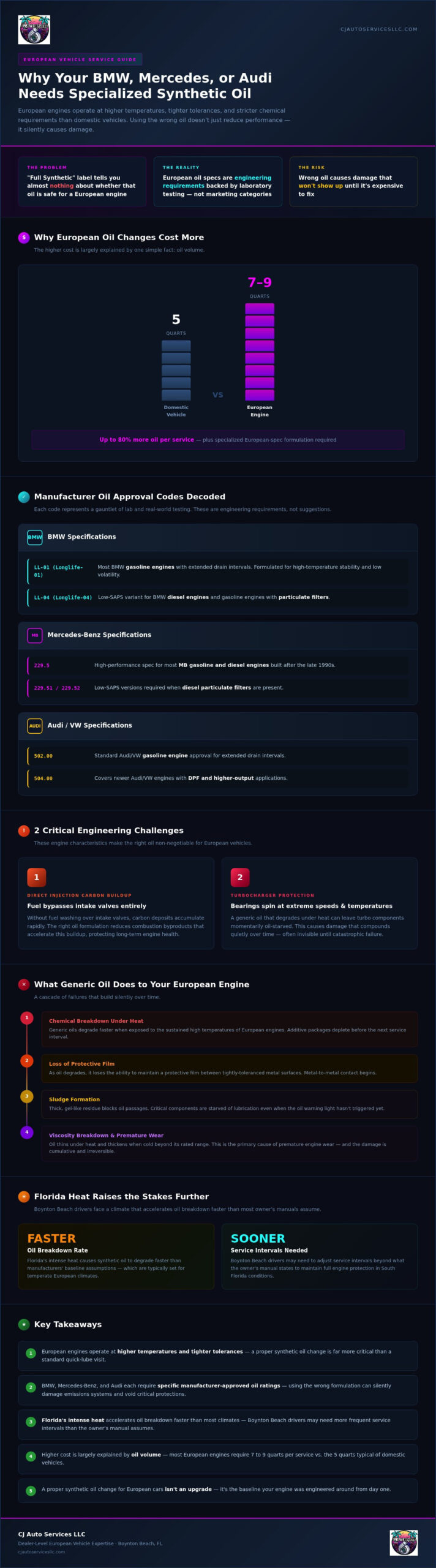
- European engines operate at higher temperatures and tighter tolerances than most domestic models, making a proper synthetic oil change for European cars far more critical than a standard quick-lube visit.
- BMW, Mercedes-Benz, and Audi each require specific manufacturer-approved oil ratings — using the wrong formulation can silently damage emissions systems and void critical protections.
- Florida’s heat accelerates oil breakdown faster than most climates, which means Boynton Beach drivers may need to adjust their service intervals beyond what the owner’s manual assumes.
- The higher cost of European oil changes is largely explained by oil volume — most European engines require 7 to 9 quarts per service, not the 5 quarts typical of domestic vehicles.
- CJ Auto Services LLC offers dealer-level European vehicle expertise in Boynton Beach, including a comprehensive multi-point inspection with every specialized oil service.
Why Your European Car Needs More Than a Standard Synthetic Oil Change
Walk into any quick-lube shop and you’ll find shelves of bottles labeled “Full Synthetic.” It sounds reassuring. The problem is that label tells you almost nothing about whether that oil is actually safe for your BMW, Mercedes-Benz, or Audi. European-spec synthetic oil isn’t just a marketing category. It’s a precisely engineered lubricant formulated to meet specific chemical, thermal, and mechanical demands that generic oils simply aren’t designed to handle.
European automakers don’t publish vague recommendations. They publish approval standards with alphanumeric codes like BMW Longlife-04, Mercedes-Benz 229.5, and Audi 507.00. These aren’t suggestions. They’re engineering requirements backed by extensive testing, and they exist because European engines operate under conditions that push standard lubricants past their limits.
The Engineering Behind the Requirement
European engines are built to tighter tolerances than most domestic counterparts. The clearances between moving metal components are smaller, which means oil must flow precisely and consistently under high pressure without breaking down. Brands like BMW and Mercedes-Benz also commonly run higher operating temperatures as a deliberate design choice to improve combustion efficiency.
Two specific challenges make the right oil non-negotiable:
- Direct-injection carbon buildup: European engines frequently use gasoline direct injection, where fuel bypasses the intake valves entirely. Without the cleaning effect of fuel washing over them, intake valves accumulate carbon deposits rapidly. The right oil formulation reduces combustion byproducts that accelerate this buildup.
- Turbocharger protection: The majority of modern European vehicles are turbocharged. Turbo bearings spin at extraordinarily high speeds and temperatures. Approved synthetic oils maintain their protective film under these conditions. A generic oil that degrades under heat can leave turbo components momentarily oil-starved, which causes damage that compounds quietly over time.
European manufacturers also developed what’s known as “Long Life” or LL-rated oils specifically for extended drain intervals. These formulations resist oxidation and additive depletion far longer than conventional synthetics, which is why some European service intervals are measured in miles that would seem aggressive by domestic standards.
The Problem with Conventional or Generic Oils
Generic oils break down chemically faster when exposed to the sustained heat of a European engine. As they degrade, they lose their ability to maintain a protective film between metal surfaces. This leads to sludge formation, a thick, gel-like residue that blocks oil passages and starves critical components. Viscosity breakdown, where oil thins under heat and thickens when cold beyond its rated range, is the primary cause of premature engine wear in vehicles running non-approved lubricants.
A proper synthetic oil change for European cars isn’t an upgrade. It’s the baseline your engine was engineered around from day one.
Decoding Manufacturer Specs: BMW, Mercedes, and Audi Requirements
European automakers don’t hand out approval codes casually. Each alphanumeric rating on an oil bottle represents a gauntlet of laboratory and real-world testing that generic oils simply never attempt. Understanding what these codes actually mean is the difference between protecting your engine and quietly degrading it one oil change at a time.
Here’s a quick reference for the most common manufacturer approvals you’ll encounter:
- BMW Longlife-01 (LL-01): Required for most BMW gasoline engines using extended drain intervals. Formulated for high-temperature stability and low volatility.
- BMW Longlife-04 (LL-04): A Low-SAPS variant designed specifically for BMW diesel engines and gasoline engines equipped with particulate filters.
- Mercedes-Benz 229.5: A high-performance gasoline and diesel spec covering most MB engines built after the late 1990s.
- Mercedes-Benz 229.51 / 229.52: Low-SAPS versions required when diesel particulate filters are present.
- Audi / VW 502.00 / 504.00 / 507.00: Volkswagen Group approvals covering everything from standard gasoline engines (502.00) to extended-drain diesel applications (507.00).
Your owner’s manual lists the exact code your engine requires. That number is not interchangeable with a similar-sounding one, even within the same brand’s lineup.
Understanding SAPS and Emission Protection
SAPS stands for Sulfated Ash, Phosphorus, and Sulfur. These are chemical compounds found in conventional oil additives, and while they serve a protective function inside the engine, they’re destructive to modern exhaust systems. When high-SAPS oil burns and its combustion byproducts pass through the exhaust, sulfur compounds react with oxygen sensors and catalytic converter substrates, gradually poisoning them. Diesel particulate filters are especially vulnerable; ash accumulates inside the filter matrix and cannot be regenerated away like soot can. A clogged DPF is an expensive replacement, not a cleaning job. Low-SAPS oils reduce these deposits dramatically, which is why they’re mandatory for any European vehicle equipped with these systems. Proper overall maintenance, including services like Audi AC repair in Boynton Beach, follows the same principle: every system in your vehicle performs better when the connected systems around it are properly maintained.
The High Cost of “Approved” Labels
There’s a critical distinction hiding on oil bottle labels: “meets requirements” and “officially approved” are not the same thing. A bottle claiming it “meets” BMW LL-04 standards has been self-certified by the manufacturer. An oil carrying the actual BMW approval stamp has been independently tested and licensed by BMW AG. That process involves viscosity testing across temperature extremes, oxidation resistance trials, and compatibility verification with seals and gaskets specific to that engine family.
Using a non-approved oil on a vehicle still under manufacturer warranty can create complications when claiming coverage for engine-related failures. The burden falls on the owner to demonstrate the oil used was appropriate. That’s a conversation nobody wants to have at a dealership service counter.
A proper synthetic oil change for European cars starts with reading that owner’s manual code and verifying the oil bottle carries the matching approval stamp, not just a marketing claim. If you’re unsure which approval your specific model requires, the team at CJ Auto Services LLC can verify the correct specification before any service begins.
The Risk of Generic Oil Changes: Protecting Your Engine’s Longevity
When a Boynton Beach driver gets quoted significantly more for a synthetic oil change for European cars than what they’d pay at a chain quick-lube, the instinct is to assume someone’s padding the bill. That frustration is understandable. But the price difference isn’t padding. It’s math, and once you see the breakdown, it makes complete sense.
Volume and Quality: Why the Bill is Higher
Most domestic engines take around 5 quarts of oil per service. European engines are a different story. A BMW N55 or Mercedes-Benz M276 engine typically requires 7 to 9 quarts per oil change. That’s not a rounding error; it’s a fundamental design difference. Premium European-spec synthetics from brands like Motul or Liqui Moly carry a meaningfully higher per-quart cost than the bulk generic oil sitting in a quick-lube’s drum. Multiply that by 8 quarts, add a manufacturer-approved cartridge-style filter (which is more complex and more expensive to produce than a standard spin-on filter), and the price difference becomes straightforward arithmetic rather than a markup.
The smaller details matter too. European drain plugs frequently require new crush washers or precision O-rings at every service. Skip those, and you’re looking at slow seeps that turn into bigger problems. At CJ Auto Services LLC, every european automotive repair service uses the correct replacement hardware and only oils that meet the manufacturer’s actual approval specifications, not self-certified substitutes.
Preventative Inspection During Service
A quick-lube visit is transactional by design. The goal is speed, and a 15-minute turnaround doesn’t leave room for the kind of observation that protects a BMW or Audi long-term. A technician who knows these platforms will use the oil change as an opportunity to check for early signs of oil filter housing gasket seepage, valve cover leaks, and coolant intrusion, all common failure points that are far cheaper to address when caught early.
There’s also the matter of service resets. European vehicles use sophisticated onboard maintenance systems that don’t simply reset with a generic scan tool. Resetting a BMW Condition Based Service indicator or a Mercedes-Benz ASSYST system incorrectly can result in inaccurate service reminders that leave you either over-servicing or unknowingly running past a critical interval.
Computerized diagnostics add another layer of protection. Hidden oil pressure codes or early sensor faults rarely trigger a warning light immediately. A proper diagnostic scan during service catches these signals before they escalate into something that grounds your vehicle entirely.
The higher cost of a proper synthetic oil change for European cars reflects what’s actually going into the service. Volume, quality, precision hardware, and expertise aren’t upsells. They’re the baseline.
Optimal Service Intervals for Boynton Beach Driving Conditions
The factory service interval printed in your owner’s manual was calculated by engineers working in a controlled environment, not in a Boynton Beach parking lot in August. That 10,000-mile figure assumes average ambient temperatures, moderate driving cycles, and a climate that doesn’t push thermal stress onto your engine before you’ve even left the neighborhood. South Florida is not that climate. For local drivers, adjusting your synthetic oil change for European cars to a 5,000 to 7,500-mile interval is a practical, protective decision, not an overcautious one.
The Florida Heat Factor
High ambient temperatures compound the thermal load your engine already generates. When outside air is consistently in the upper 80s or 90s, the engine’s cooling system has less thermal headroom to work with. Oil that might last 10,000 miles in a temperate climate reaches its oxidation threshold faster here because it’s working harder from the moment you start the car.
Short trips make this worse. When a drive ends before the engine reaches full operating temperature, moisture that accumulates in the crankcase during startup never fully evaporates. Over time, that moisture mixes with combustion byproducts and accelerates acid formation inside the oil pan. South Florida’s humidity means more moisture enters the system with every cold start, and the repeated heat cycles of stop-and-go traffic on Congress Avenue or Federal Highway degrade synthetic additives faster than steady highway miles ever would.
Snowbird Maintenance: The “Once a Year” Rule
Seasonal residents face a different problem. A European vehicle that sits for five or six months isn’t in a safe holding pattern just because it hasn’t accumulated mileage. Synthetic oil additives settle and separate during extended storage. The protective chemistry that keeps metal surfaces coated during startup is diminished by the time you return in the fall.
There’s also the corrosion risk. Engines that aren’t regularly driven to full operating temperature allow moisture and combustion acids to sit against internal metal surfaces rather than being burned off. That quiet exposure causes wear that shows up later as premature bearing or cylinder wear.
The practical solution is straightforward: schedule an oil service either before you leave or immediately upon your return, not based on mileage, but based on time. Fresh oil going into storage means protective additives are at full strength when the car sits. Fresh oil after storage means you’re not running on degraded lubricant during the critical first drives of the season.
If you’re unsure whether your current oil has reached its service point based on time rather than miles, the team at CJ Auto Services LLC can inspect the oil condition and advise on the right interval for how you actually use your vehicle. Schedule a European oil service in Boynton Beach before the next season begins.
Specialized European Oil Service at CJ Auto Services LLC
Finding a shop that genuinely understands your BMW, Mercedes-Benz, or Audi is harder than it sounds. Most general repair facilities can drain and refill oil. Far fewer can verify the correct manufacturer approval code, reset a Condition Based Service indicator accurately, and catch an early oil filter housing leak before it becomes a warranty conversation. CJ Auto Services LLC was built around exactly that level of specificity, serving Boynton Beach drivers who want dealer-level expertise without the dealer-level experience of sitting in a waiting room for four hours.
As a family-owned shop specializing in European, Japanese, and diesel vehicles, CJ Auto Services approaches every service appointment as a long-term investment in your vehicle, not a transaction to complete as quickly as possible. That difference in mindset shows up in the details.
Expertise Beyond the Basics
Every synthetic oil change for European cars at CJ Auto Services includes a comprehensive multi-point inspection performed by technicians who work on these platforms daily. That inspection covers:
- Oil filter housing gaskets and valve cover seals for early seepage that’s inexpensive to address now and costly to ignore later
- Brake system condition, including pad thickness and rotor surface integrity
- Suspension and steering components, which European vehicles stress differently than domestic models
- Battery load testing, critical for vehicles with high electrical demand and start-stop systems
- Fluid condition across all systems, not just the oil being replaced
The shop uses manufacturer-specific diagnostic tools for Audi, BMW, and Mercedes-Benz, which means service resets are performed correctly and any stored fault codes are reviewed before you leave. Only manufacturer-approved synthetic oils go into every European engine, with the specific approval code verified against your vehicle’s requirements before the service begins. CJ Auto Services also handles diesel engine maintenance and full service auto repair, including performance tuning for drivers who want more from their vehicle than factory output.
Booking Your Appointment in Boynton Beach
Scheduling is straightforward. The Boynton Beach location is convenient for local commuters whether you’re coming from the north along Federal Highway or cutting across from the western communities. Drop-off before work is a practical option, and the team communicates clearly about what they find and what it means before any additional work is approved.
The peace of mind CJ Auto Services provides comes from transparency: you know what oil went in, what approval code it carries, and what the inspection found. No guesswork, no generic substitutes, no surprises. If your European vehicle is due for service, or if you’re unsure whether your current oil has held up through a Florida summer, reach out to CJ Auto Services LLC and let a specialist take a proper look.
Keep Your High-Performance Engine Running Smoothly in Boynton Beach
Your BMW, Mercedes, or Audi is a masterpiece of engineering. Protecting that investment means moving beyond generic maintenance and embracing the specific chemical requirements your vehicle was built for. By choosing manufacturer-approved lubricants and adjusting your service schedule for the South Florida climate, you prevent premature wear and avoid the expensive repairs that come from using the wrong oil. A specialized synthetic oil change for European cars is more than just fresh fluid; it’s a comprehensive health check for your engine.
CJ Auto Services LLC provides a trusted local alternative to the dealership, specializing in BMW, Mercedes, Audi, and diesel engines. Every service includes comprehensive engine diagnostics to give you total peace of mind before you get back on the road. We take pride in our expertise and value the relationship we build with every driver who walks through our doors.
Schedule Your Expert European Oil Change at CJ Auto Services LLC Today!
Your car deserves expert care that respects your time and your budget. We look forward to helping you extend the life of your luxury vehicle.
Frequently Asked Questions
Does my European car really need synthetic oil, or can I use a blend?
Yes, your European vehicle requires full synthetic oil to meet manufacturer standards. Synthetic blends don’t provide the same level of protection against high-temperature breakdown or the shear resistance needed for precision-engineered engines. Using anything less than a full synthetic can lead to carbon buildup and reduced engine life.
Why is my BMW oil change so much more expensive than my Ford oil change?
The price difference is primarily due to the volume and grade of oil required. A BMW engine typically holds between 7 and 9 quarts of premium synthetic oil, whereas a standard domestic car might only require 5 quarts. Additionally, European cars use specialized cartridge filters rather than basic spin-on filters, which adds to the material costs.
Can I wait for the 10,000-mile interval suggested by the manufacturer?
Waiting for the full 10,000-mile interval is often not recommended for drivers in South Florida. Frequent stop-and-go traffic and high humidity qualify as severe driving conditions. We suggest a more protective interval of 5,000 to 7,500 miles to ensure your engine remains clean and properly lubricated.
What happens if I use the wrong oil spec in my Mercedes-Benz?
Using the wrong oil specification can lead to the poisoning of your catalytic converter or diesel particulate filter. Mercedes-Benz engines are highly sensitive to the chemical makeup of the oil, specifically levels of sulfur and phosphorus. Beyond mechanical wear, using non-approved oil can also lead to denied warranty claims for engine-related issues.
Do I need to change my oil more often because of the Florida heat?
Yes, the Florida heat significantly impacts oil longevity by accelerating thermal breakdown. When temperatures soar, the additives in your oil work harder to prevent friction and oxidation. This makes a timely synthetic oil change for European cars essential for maintaining engine performance during our long, hot summers.
How long does a professional European synthetic oil change take at CJ Auto?
A specialized oil service at our shop usually takes about 45 to 60 minutes. This timeframe allows our technicians to perform a proper drain and fill while also completing a multi-point inspection. We take the time to check your brakes, suspension, and fluid levels to give you total peace of mind on the road.
Will getting my oil changed at an independent shop void my warranty?
No, using an independent specialist will not void your manufacturer warranty. You have the legal right to choose where your car is serviced. As long as the shop uses manufacturer-approved fluids and follows the correct procedures, your warranty remains fully protected. We always document our work to help you maintain your service history.
What are the signs that my European car is overdue for an oil change?
Common signs include a persistent ticking sound upon startup, darker or grittier oil on the dipstick, and a noticeable drop in fuel efficiency. If you experience a burning oil smell or see smoke from the exhaust, your oil has likely lost its protective qualities. Don’t wait for a warning light to appear before seeking a professional synthetic oil change for European cars.