Imagine you’re merging onto I-95 during a heavy afternoon downpour when the traffic ahead suddenly comes to a halt. You press your pedal, but instead of a firm, immediate response, you feel a soft pulse and hear a faint, metallic screech. It’s a moment of pure anxiety that no driver should have to face, yet many residents postpone their brake repair in Boynton Beach because they aren’t sure who to trust or if that new noise is truly an emergency.
We understand that navigating car maintenance can feel overwhelming, especially when you’re worried about being overcharged for parts you don’t need. You’re right to be cautious, as your vehicle’s stopping power is your primary line of defense on the road. Our goal is to provide the peace of mind that comes from knowing your car is handled by a master craftsman who values your safety and your time.
In this guide, you’ll master the common signs of brake wear and understand how the intense Florida heat accelerates damage to your pads and rotors. We’ll also clarify the vital differences between standard and specialized European brake services. By the end, you’ll know exactly what’s causing that squeak and how to find a reliable local expert to keep your vehicle performing at its best.
Key Takeaways
- Learn to identify the specific sounds and sensations of failing pads before they lead to costly rotor damage.
- Understand how Florida’s high humidity and extreme road heat can degrade your stopping power and necessitate specialized brake repair boynton beach.
- Discover why European models like BMW and Audi require specific materials and electronic sensor monitoring to maintain peak safety.
- Demystify your vehicle’s hydraulic system to better understand how pressure is converted into reliable stopping force.
- Explore a transparent, multi-point inspection process that uses real measurements to show you exactly when it’s time for a replacement.
What Are the Essential Components of a Modern Braking System?
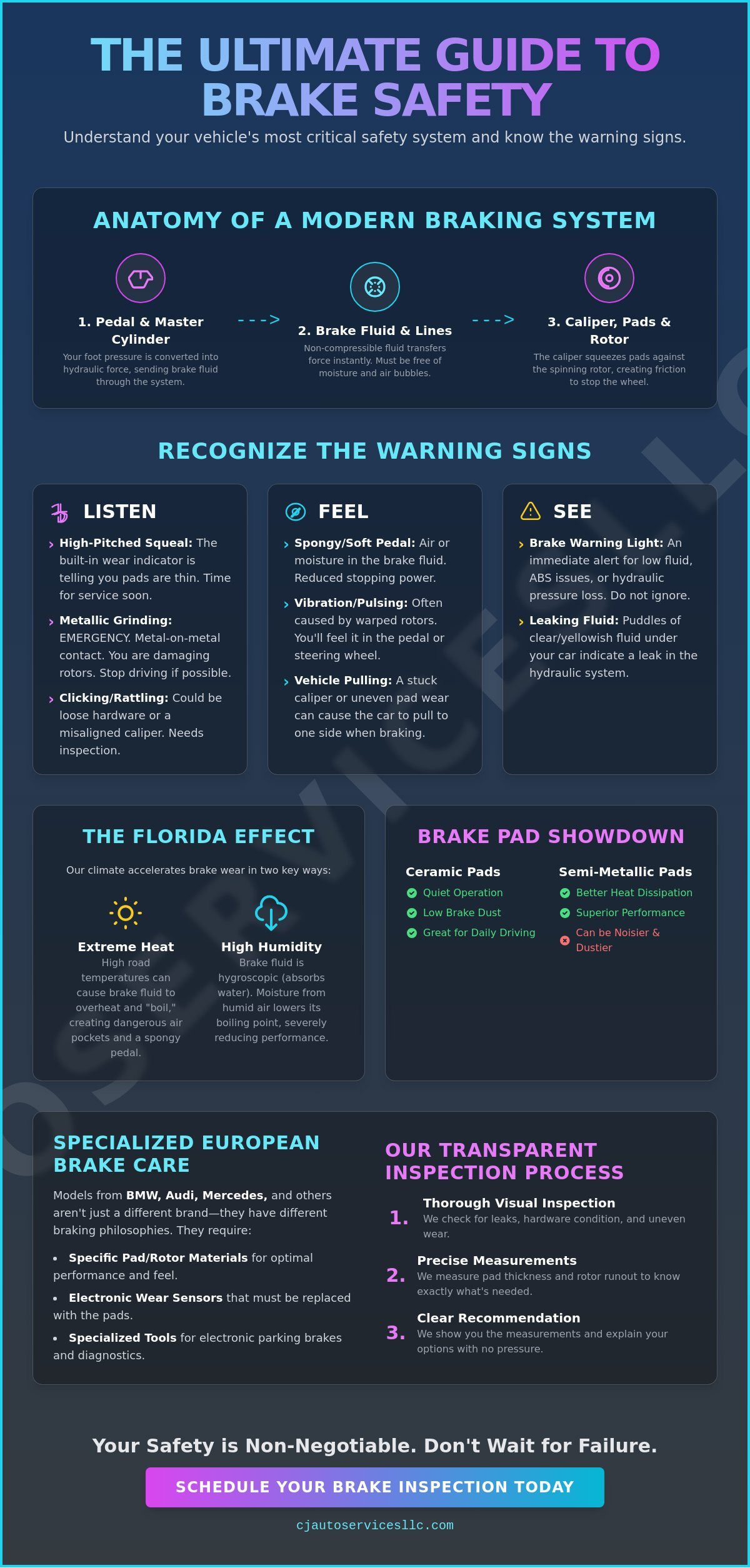
Your car’s braking system is a marvel of engineering that turns kinetic energy into heat. Understanding how braking systems work starts with the pedal. When you press down, you aren’t just moving a lever. You’re triggering a complex hydraulic-to-mechanical conversion. This process begins at the master cylinder. It sends pressurized fluid through specialized lines to the calipers at each wheel. These calipers act like clamps. They force the brake pads against the spinning rotors to bring your vehicle to a safe, controlled stop. This chain of events happens in a fraction of a second, but every link must be strong to ensure your safety.
In our local environment, the Anti-lock Braking System (ABS) is a literal lifesaver. During those sudden Boynton Beach tropical downpours, the ABS prevents your wheels from locking up and sliding on slick pavement. It pumps the brakes hundreds of times per second. This allows you to maintain steering control when you need it most. It’s why high-quality brake repair in Boynton Beach involves checking both the mechanical hardware and the electronic sensors that keep these systems communicating. Without a functional ABS, a simple stop on a wet road could turn into a dangerous skid.
Brake Pads vs. Rotors: The Friction Duo
Think of your pads and rotors as a team. The rotor is a heavy metal disc that spins with your wheel, while the pads are the replaceable friction material that grips it. We often see two main types of pads. Ceramic pads are popular for their quiet operation and low dust, making them great for daily commuting. Semi-metallic pads contain more metal. This helps dissipate heat more effectively during heavy-duty use. Most modern pads include a small metal “wear indicator” tab. When the pad gets too thin, this tab touches the rotor and creates that signature high-pitched squeal. It’s a built-in alarm telling you it’s time for service before you damage the more expensive rotors.
The Vital Role of Brake Fluid
Brake fluid is the lifeblood of the entire system. Because it’s a non-compressible liquid, it transfers the force from your foot directly to the wheels without delay. However, fluid condition is just as critical as pad thickness. Over time, fluid absorbs moisture from the air. This is a major concern given our local humidity levels. This moisture lowers the fluid’s boiling point. In heavy traffic or stop-and-go driving, overheated fluid can actually “boil.” This creates air bubbles that make your pedal feel spongy and dangerous. Regular fluid flushes ensure your stopping power remains consistent regardless of the temperature outside.
Identifying Common Symptoms of Brake Wear and Failure
Your vehicle has several ways of telling you it’s time for a checkup. Most drivers notice a change through sound, sight, or physical sensation. While it’s tempting to turn up the radio to drown out a new squeak, ignoring these signals often leads to much higher costs. Many customers ask if they can wait another week. The truth is that waiting usually turns a simple pad replacement into a much larger bill for new rotors or calipers. Beyond the cost, adhering to Federal motor vehicle safety standards is essential for keeping everyone on the road safe. If you notice a sudden loss of stopping power or a pedal that sinks to the floor, do not drive the vehicle. Safety is always the priority.
It’s helpful to distinguish between minor issues and emergencies. For example, a light scraping sound first thing in the morning is often just surface rust clearing off the rotors after a humid Florida night. This is normal. However, if a noise persists after a few blocks, it’s a sign of real wear. Keeping an eye on your dashboard is also vital. A brake warning light isn’t a suggestion; it’s an alert that your hydraulic pressure or fluid levels might be compromised. When you’re looking for expert brake repair boynton beach, catching these signs early makes the process much smoother.
Auditory Warnings: Squeals, Screeches, and Grinds
The most common sound is a high-pitched squeal. As we discussed earlier, this is often your wear indicator doing its job. It’s a proactive warning that your pads are thin. If that squeal turns into a deep, metallic grinding, you’ve reached total pad failure. Metal is now rubbing against metal, which can destroy your rotors in minutes. You might also hear clicking or rattling over bumps. This often points to loose hardware or a caliper that isn’t sitting quite right. These sounds are your car’s way of asking for a professional look before a small fix becomes a major overhaul.
Physical Sensations: Pulsing, Pulling, and Sponginess
Your hands and feet often feel trouble before your ears hear it. If your steering wheel vibrates or the brake pedal pulses when you slow down from highway speeds, your rotors are likely warped or have developed “hot spots” from overheating. If the car pulls to one side when you brake, you might have uneven pad wear or a sticking caliper. A “spongy” pedal is also concerning. If the pedal feels soft or requires you to pump it to stop, you likely have air in your lines or a failing master cylinder. If your car isn’t handling the way it used to, it’s time for a professional inspection to restore your confidence. A specialist in brake repair boynton beach can diagnose these physical cues correctly the first time.
Why Boynton Beach Drivers Face Unique Brake Challenges
Boynton Beach offers beautiful sunshine and coastal breezes, but these same elements create a punishing environment for your vehicle. Most drivers don’t realize that the local climate directly impacts the frequency of brake repair boynton beach. The combination of high humidity, extreme asphalt temperatures, and stop-and-go traffic on Congress Avenue creates a perfect storm for mechanical wear. If you live closer to Ocean Boulevard, the salt air adds another layer of complexity by accelerating corrosion on exposed metal components like your rotors and calipers. Understanding these local factors helps you stay ahead of potential failures.
Heat is the primary enemy of any friction-based system. When you’re driving in South Florida, your brakes start at a higher baseline temperature because of the radiant heat from the pavement. This makes it much harder for the system to cool down after a hard stop. Over time, this constant thermal stress can lead to pad crystallization. This happens when the friction material hardens and becomes glazed, significantly reducing your stopping power and often causing a persistent squeal that won’t go away.
Humidity and Brake Fluid Contamination
Managing these environmental factors is a statewide challenge. For readers with properties in Southwest Florida, Ultra Air Heating and Cooling offers specialized expertise in residential and commercial climate solutions, helping to protect indoor environments from the same heat and humidity that affect your vehicle.
Florida’s humidity is more than just a comfort issue. Brake fluid is hygroscopic, which means it actively attracts and absorbs moisture from the surrounding air. In Boynton Beach, where the air is consistently saturated with water vapor, your fluid can become contaminated faster than in drier states. This moisture is dangerous because it lowers the boiling point of the fluid. During a sudden stop or heavy use, the water inside your lines can turn into steam. This creates a vapor lock where the pedal feels soft and your stopping distance increases. Because of this local reality, we often recommend fluid flushes more frequently than the standard manufacturer intervals to keep your system responsive.
Stop-and-Go Traffic and Heat Dissipation
Commuting along Federal Highway or navigating the lights on Gateway Boulevard puts immense stress on your friction components. Every time you stop, your pads and rotors generate friction heat. In cooler climates, these parts cool down quickly between stops. However, Boynton Beach road surfaces can reach 140 degrees in the summer sun. This prevents your rotors from shedding heat effectively. When rotors stay hot for too long, they can develop heat spots or become warped. To preserve your brake life, try to avoid riding the pedal in traffic. Leaving more space between you and the car ahead allows for smoother stops. This simple habit helps manage heat cycles and ensures your brake repair boynton beach needs remain routine rather than emergency-driven.
Specialized Brake Care for European and Performance Vehicles
Driving a BMW, Mercedes, or Audi in South Florida is a unique experience that requires a specialized approach to maintenance. These vehicles feature braking systems engineered for the high-speed demands of the European Autobahn. This engineering translates to superior stopping power on I-95, but it also means the components are highly sensitive. When you’re looking for quality brake repair boynton beach, it’s vital to choose a shop that understands these nuances. Standard domestic parts often lack the specific metallurgy required for these high-performance rotors. Choosing European automotive repair ensures that your vehicle receives the exact components it was designed to use. High-performance calipers also require a master’s touch. Every bolt must be tightened to precise torque specifications. Even a small error in tension can lead to vibration or premature wear on your steering and suspension.
The complexity of these systems means that a one-size-fits-all approach simply won’t work. Performance calipers often use multiple pistons to apply even pressure across the pad. If these aren’t serviced with precision, you might experience uneven pad wear or a pulling sensation during hard stops. Our goal is to maintain the factory feel of your vehicle, ensuring it handles exactly the way the engineers intended. We take pride in our technical confidence, allowing you to drive with the peace of mind that your specialized vehicle is in expert hands.
European Brake Pad Compounds
Many owners of European cars are surprised by the amount of dark dust they see on their front wheels. This dust is actually a sign of quality. European manufacturers typically use softer brake pad compounds. These softer materials provide a more aggressive “initial bite” and better modulation than the harder pads often found on domestic trucks or economy cars. While the dust is a minor inconvenience, it represents the friction needed to stop a heavy luxury vehicle quickly. Some shops might offer “low-dust” aftermarket pads as a cheap alternative. However, these often have a different friction coefficient. Using the wrong pad can lead to rotor glazing or increased stopping distances. We prioritize your safety by always matching the friction materials to the manufacturer’s original standards.
Digital Integration and Resetting Service Lights
Modern braking is as much about software as it is about hardware. Most European models are equipped with electronic wear sensors that plug directly into the brake pads. These sensors provide a precise reading to your car’s computer. Once these sensors are triggered, the physical repair is only part of the solution. A technician must use advanced computerized diagnostics to communicate with the vehicle’s ECU. This process resets the service counters and ensures the car knows new hardware is installed. This digital integration is a standard part of our full service auto repair philosophy. We don’t believe a job is finished until both the mechanical and electronic systems are synchronized. It’s this attention to detail that provides the peace of mind our customers expect.
If your dashboard is signaling for service, don’t settle for a generic fix. Contact our master craftsmen to give your European vehicle the specialized brake repair boynton beach attention it deserves. BMW owners should also be aware that the same South Florida heat and humidity that stress your brakes can wreak havoc on your cabin comfort — our dedicated BMW AC repair service in Boynton Beach ensures your entire vehicle is protected from Florida’s punishing climate. Mercedes-Benz owners face the same climate challenge, and our specialized Mercedes A/C repair service keeps your advanced THERMATIC and THERMOTRONIC climate control systems performing flawlessly alongside your brakes in the South Florida heat.
The Professional Brake Service Process at CJ Auto Services
Choosing a partner for your vehicle shouldn’t feel like a gamble. At CJ Auto Services, we’ve built our reputation on a foundation of transparency and technical precision. When you visit us for brake repair boynton beach, we don’t just tell you what’s wrong. We show you. Our multi-point visual and mechanical inspection is designed to take the mystery out of car maintenance. We walk you through the condition of your friction components, explaining exactly why a part needs attention or why it’s still safe for another season. By treating you as a partner in the process, we aim to alleviate the typical stress of the repair shop experience.
We believe that quality work requires both the right tools and a disciplined approach. This is why we exclusively use premium parts and factory-grade fluids. We don’t cut corners with “white box” generic components that might fail prematurely in our harsh Florida heat. Every step of our service is focused on restoring your vehicle’s original performance and providing you with long-term reliability. It’s a methodical process that reflects our commitment to professional ethics and neighborly warmth.
Precision Measurements and Diagnostics
We rely on hard data, not guesses. Our technicians use high-precision micrometers to measure rotor thickness and check for runout. This ensures your rotors aren’t just “okay” but meet the exact safety tolerances required for your specific model. Given our local climate, we also prioritize testing your brake fluid for moisture content. As we noted earlier, South Florida humidity can compromise your fluid’s boiling point. We use digital testers to verify the fluid is still protecting your system. We also perform a rigorous sweep of all brake lines and hoses, looking for the smallest cracks or leaks that could lead to a sudden loss of pressure on the road.
Quality Installation and Performance Testing
The installation is where the master craftsman’s skill truly shines. We don’t just “slap on” new pads. We take the time to clean and lubricate your caliper slides. This simple step prevents the sticking that causes uneven wear and annoying squeaks. Once the hardware is in place, we perform a vital “bedding” process. This involves a series of controlled stops to transfer a thin layer of friction material from the pad to the rotor. This transfer layer is what actually stops the car and significantly extends the life of your new brakes. Finally, every vehicle undergoes a professional road test. We verify the pedal feel, the noise levels, and the stopping distance to ensure you leave with total peace of mind.
Your safety is too important for a “good enough” repair. If you’re ready for a higher standard of care, visit CJ Auto Services for a professional safety check that puts your needs first. Our team is ready to provide the expert brake repair boynton beach drivers trust for their families and their vehicles.
Secure Your Stopping Power Today
Your vehicle’s brakes are its most critical safety feature, especially when facing unpredictable South Florida weather and traffic. We’ve explored how local humidity can contaminate your fluid and why European models like BMW or Audi require specific metallurgy to perform at their peak. Catching these symptoms early doesn’t just save you money on rotors; it ensures your car responds exactly when you need it most on I-95. Understanding the difference between a minor squeak and a critical failure is the first step toward maintaining a reliable vehicle.
Since 2020, CJ Auto Services has operated as a family-owned shop dedicated to providing this level of precision. As a full-service facility with deep expertise in high-performance tuning, we bring a master craftsman’s eye to every brake repair boynton beach project. Whether you drive a domestic daily commuter or a precision-engineered Mercedes, you deserve a partner who values transparency and your family’s safety above all else. For Mercedes owners, keeping your luxury vehicle fully protected means addressing every system — from brakes to the cabin — which is why pairing your brake service with expert Mercedes A/C repair service in Boynton Beach ensures your vehicle is comprehensively maintained against Florida’s demanding climate. We’re ready to show you the measurements, explain the process, and get you back on the road safely.
Schedule Your Professional Brake Inspection at CJ Auto Services and drive with the peace of mind you deserve. We look forward to seeing you at the shop soon.
Frequently Asked Questions
How much does brake repair cost in Boynton Beach?
Total repair costs depend on your vehicle’s specific make and the extent of the component wear. A simple pad replacement for a domestic sedan differs significantly from a full rotor and caliper service on a high-performance European SUV. We provide clear, written estimates after a physical inspection so you know exactly what to expect before we begin any work on your vehicle.
How long do brake pads typically last in South Florida traffic?
Most brake pads last between 30,000 and 60,000 miles, but South Florida’s stop-and-go traffic often shortens this lifespan. The extreme heat on Congress Avenue causes friction materials to wear down faster than in cooler climates. If you are looking for reliable brake repair boynton beach, we recommend having your pad thickness measured every six months to avoid reaching the dangerous metal-on-metal stage.
Why are my brakes squeaking even though the pads are new?
New brakes might squeak if the pads weren’t properly “bedded” or if the rotors weren’t cleaned of their protective shipping oil during installation. It can also happen if the technician didn’t lubricate the caliper contact points or if low-quality, “hard” pads were used. If the sound persists after 200 miles of driving, a professional inspection is necessary to ensure everything is seated correctly.
Is it safe to drive with the brake warning light on?
It is not safe to drive with a brake warning light illuminated on your dashboard. This light often signals low hydraulic fluid or a loss of pressure in the system, which could lead to total brake failure. If the light appears, pull over safely and check your pedal feel. It’s best to have your vehicle towed for professional brake repair boynton beach rather than risking a collision.
What is the difference between resurfacing and replacing rotors?
Resurfacing involves “turning” the rotor on a lathe to remove a thin layer of metal and make the surface flat again. However, many modern rotors are made thinner to save weight and don’t have enough material to be safely resurfaced. We always measure the thickness with a micrometer. If the rotor is below the manufacturer’s minimum safety limit, we recommend a full replacement to prevent cracking.
How often should I have my brake fluid flushed?
We recommend a brake fluid flush every two years or 20,000 miles due to our intense local humidity. As discussed earlier, brake fluid absorbs moisture from the air, which can lead to internal corrosion and a spongy pedal. Testing the fluid for water content during your regular oil change is the best way to determine if a flush is needed sooner to protect your system.
Can I just replace the front brakes and wait on the rear?
You can replace just the front or rear sets because they don’t wear at the same rate. The front brakes usually handle about 70 percent of the stopping power and wear out much faster than the rears. While it’s fine to wait on the rear pads if they still have adequate thickness, you should always replace pads in pairs on the same axle to maintain balanced stopping.
Why do my European car brakes make so much black dust?
European manufacturers use softer friction materials to provide the high-performance “bite” required for Autobahn speeds. This softer compound wears away more visibly, creating the dark carbon dust you see on your wheels. While it’s messy, this dust is a byproduct of the superior stopping power and heat management found in BMW, Mercedes, and Audi systems. Regular cleaning helps prevent the dust from pitting your wheel finish.




One thought on “The Ultimate Guide to Brake Repair in Boynton Beach: Your Safety Questions Answered”
Comments are closed.