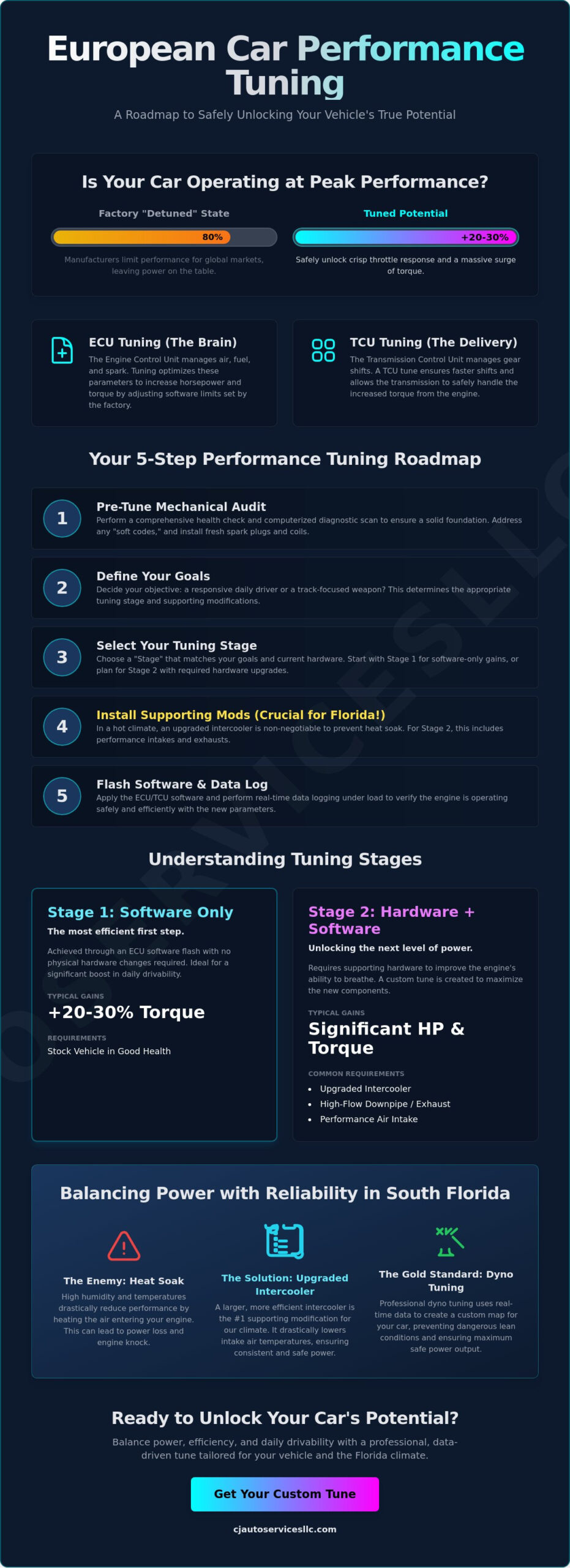
What if your European vehicle is currently operating at only 80% of its true capability? Most manufacturers detune engines for a global average, leaving a massive reservoir of power and responsiveness untapped under your hood. You likely want that crisp throttle response and surge of torque for your daily drive, but the fear of a voided warranty or a melted engine in the South Florida heat keeps you hesitant. It’s a common concern; nobody wants to turn a reliable daily driver into a temperamental project car that can’t handle the local climate.
This guide shows you how to master european car performance tuning safely while keeping your peace of mind intact. We’ll explain why the Motor Vehicle Block Exemption Regulation (MVBER) protects your right to use independent experts and how to navigate the new 2026 Florida noise standards. You’ll learn the exact order of modifications to balance cooling with raw power. We cover everything from Stage 1 software basics to high-performance hardware upgrades, ensuring your car stays fast, cool, and completely drivable.
Key Takeaways
- Begin with a comprehensive mechanical health check and computerized diagnostics to ensure your car’s foundation is solid before adding power.
- Navigate the terminology of european car performance tuning by learning when to stop at a Stage 1 software flash or move to Stage 2 hardware upgrades.
- Protect your engine from the South Florida humidity by prioritizing upgraded intercoolers to combat performance-killing heat soak.
- See how professional dyno tuning acts as the “gold standard” for safety, using real-time data to prevent engine knock and lean conditions.
- Master the art of balancing increased torque and throttle response with daily drivability for a seamless, hassle-free ownership experience.
The Fundamentals of European Car Performance Tuning
Your European vehicle is essentially a high-performance computer on wheels. Understanding The Fundamentals of European Car Performance Tuning starts with the Engine Control Unit (ECU). This computer acts as the brain, managing the critical dance between air, fuel, and spark. Most owners don’t realize that manufacturers intentionally detune these vehicles at the factory. They do this to account for poor fuel quality in certain global markets, strict emissions targets, or specific tax brackets that penalize higher horsepower. By adjusting these software limits, we can safely unlock the potential your car already possesses.
It’s helpful to distinguish between ECU and TCU tuning. While the ECU manages the engine’s power, the Transmission Control Unit (TCU) dictates how that power reaches the wheels. Adjusting the TCU ensures your gear shifts are faster and that the transmission can handle the increased torque load properly. On modern turbocharged platforms, simple european car performance tuning through software can often yield a massive 20% to 30% increase in torque. This is achieved without changing a single mechanical part, making it an incredibly efficient way to enhance your vehicle’s character.
Software vs. Hardware: The Performance Synergy
Think of the software as the brain and the hardware as the muscles. Software remaps tell the engine how to utilize its existing components more effectively. For modern BMW, Audi, and VW engines, this often involves fine-tuning boost pressure and ignition timing. These engines are specifically designed for scalability. The same base engine block is often used across multiple vehicle models with different power outputs. Tuning simply bridges that gap. It allows a standard model to perform like its higher-tier siblings by safely utilizing the mechanical headroom built into the factory hardware from the start.
The Goal: Balancing Power, Efficiency, and Drivability
A common mistake is focusing only on peak horsepower numbers. True performance is about the area under the curve, which represents the usable power you feel every time you step on the gas. We prioritize a smooth power delivery that doesn’t sacrifice your daily commute in Boynton Beach. A well-executed tune can even improve your fuel economy during highway cruising because the engine operates more efficiently at steady speeds. The result is a car that’s faster and more responsive, yet remains perfectly comfortable for your everyday errands or long road trips.
How to Tune Your European Car: A Step-by-Step Roadmap
Successful european car performance tuning isn’t just about clicking “install” on a laptop. It’s a methodical process that ensures your vehicle can actually handle the new power you’re requesting. If you skip the preparation, you aren’t just risking a check engine light; you’re risking your engine’s longevity. Following a proven roadmap allows you to enjoy every bit of extra torque without the constant worry of a mechanical failure.
Phase 1: The Pre-Tune Mechanical Audit
Before you even think about software, you need a healthy baseline. Many European cars carry “soft codes” that don’t trigger a dashboard light but indicate issues like minor boost leaks or aging oxygen sensors. These small problems become massive headaches once you increase boost pressure. We always start with computerized engine diagnostics to verify every system is within its factory operating parameters. You’ll also want to install fresh spark plugs, often one heat range colder than stock, and high-quality ignition coils. Adding 50 horsepower to an engine with tired coils is a recipe for immediate misfires under load.
- Step 1: Perform a comprehensive health check and diagnostic scan.
- Step 2: Define your goals. Are you looking for a punchier daily drive or a weekend track weapon?
- Step 3: Select a “Stage” that matches your hardware. Stage 1 is typically software-only, while Stage 2 requires physical exhaust or intake changes.
- Step 4: Install supporting mods. In our climate, an upgraded intercooler is non-negotiable.
- Step 5: Flash the software and perform real-time data logging to ensure everything is running safely.
Phase 2: Choosing Your Tuning Platform
You generally have two choices: a “piggyback” module or a full ECU flash. Piggyback modules sit between the factory sensors and the ECU, tricking the car into making more boost. They’re popular because they’re easy to remove, but they lack the fine-grained control of a full flash. A full ECU flash remaps the entire logic of the engine. For most drivers, an “Off-the-Shelf” (OTS) map from a reputable tuner is perfect for standard bolt-on parts. However, if you’ve chosen a unique turbo or fuel setup, a custom tune is the only way to ensure european car performance tuning remains reliable. Balancing Power with Reliability in the Florida Heat requires staying within legal and mechanical limits to keep your car on the road instead of in the shop. If you’re unsure where your car currently stands, a quick visit for tuning and full performance evaluation can save you thousands in potential repairs.
Understanding Tuning Stages and Supporting Modifications
The world of european car performance tuning often uses “Stages” to categorize how deeply a vehicle has been modified. While these terms aren’t strictly regulated by manufacturers, they provide a helpful roadmap for enthusiasts. Understanding Tuning Stages and Supporting Modifications is vital because each level requires specific hardware to remain reliable. Stage 1 is the most popular entry point, relying almost entirely on software to optimize the factory’s hidden reserves. It’s the perfect choice for a daily driver that needs a bit more pep without sacrificing comfort.
As you progress to Stage 2, the focus shifts to airflow. This level typically requires a high-flow downpipe and intake system to manage the increased heat and pressure. Stage 3 is where things get serious. This stage often involves turbocharger or supercharger upgrades along with high-pressure fuel pumps. It’s a significant investment that transforms the car’s personality. However, we always emphasize the “Support Rule.” You should never add significant power without first upgrading your vehicle’s ability to stop and turn. More speed is only fun if you can control it safely.
Airflow and Exhaust: Letting the Engine Breathe
Think of your engine as a giant air pump. The more efficiently it breathes, the more power it makes. Cold air intakes and high-flow filters reduce turbo lag by allowing the turbocharger to spool up faster. On the back end, an upgraded downpipe reduces backpressure. This doesn’t just improve the exhaust note; it allows heat to escape the engine bay more quickly. When selecting these parts, we help you balance performance gains with the 2026 Florida noise regulations to ensure your car stays street-legal and neighbor-friendly.
Handling the Power: Brakes and Suspension
Speed is one-dimensional if your car can’t handle a corner or stop in an emergency. This is why brake repair and upgrades are mandatory for any Stage 2 or higher build. Upgrading to high-temperature pads and stainless steel lines provides the consistent stopping power needed for spirited driving. Suspension tuning through lowering springs or coilovers works in tandem with your engine’s power. It reduces body roll and improves weight transfer during acceleration. Finally, don’t overlook your tires. High-performance rubber is the only thing actually connecting all that new horsepower to the pavement. Without it, you’re just spinning your wheels.
Balancing Power with Reliability in the Florida Heat
Florida’s climate isn’t just uncomfortable for people; it’s a performance killer for engines. High ambient temperatures and thick humidity lead to a phenomenon known as “heat soak.” This happens when your cooling system can’t keep up with the heat generated by increased boost. When the air entering your engine is too hot, the ECU pulls back timing to prevent damage. This leaves you with a car that feels sluggish exactly when you want it to be fast. Keeping your car cool is the most important part of european car performance tuning in our region.
For drivers in Boynton Beach, an upgraded intercooler is your most valuable modification. Factory intercoolers often struggle after just one or two hard pulls. Larger, more efficient cores keep intake temperatures stable. This allows you to maintain peak power through every gear without the ECU intervening to protect the engine. Beyond hardware, you should monitor your engine’s vitals. Using mobile apps or digital gauges to track oil and coolant temperatures in real-time gives you the data needed to know when to back off.
You can’t stick to the factory 10,000-mile oil change interval once you’ve tuned your vehicle. More power means more heat and higher cylinder pressures. This breaks down oil faster. We recommend a high-quality synthetic oil change every 3,000 to 5,000 miles. It’s a small investment that protects your turbocharger bearings and internal engine components from premature wear.
Cooling Systems: The Secret to Longevity
Your radiator and oil coolers are the front line of defense. High-performance European engines often benefit from larger capacity units that dissipate heat more effectively. Some enthusiasts even use water-methanol injection to chemically cool the intake charge. It’s also vital to ensure your A/C system is healthy. A struggling A/C compressor adds unnecessary drag and heat to an already stressed engine bay, making the entire cooling system work harder than it should.
The Tuned Car Maintenance Checklist
Check your drive belts and hoses frequently. Increased torque puts extra stress on these rubber components, and Florida’s heat makes them brittle over time. If you have a direct-injection engine, don’t ignore carbon cleaning. Carbon buildup on valves can cause turbulence and hotspots, which is dangerous for a tuned engine. Keeping these vitals in check ensures your build stays reliable for years. If you’re ready to prep your car for the summer, schedule an engine repair and maintenance check to keep your performance gains safe.
Unlocking Potential with Professional Dyno Tuning at CJ Auto
While software flashes provide a great baseline, dyno tuning remains the gold standard for anyone serious about european car performance tuning. A chassis dynamometer allows us to simulate real-world driving conditions in a controlled environment. Instead of guessing how your car reacts to a new map, we use real-time data logging to monitor every vital sign. This process is about more than just chasing a high horsepower number. It’s about safety. By watching air-fuel ratios and ignition timing closely, we can prevent dangerous conditions like engine knock or lean runs that often go unnoticed during a standard street drive.
Professional tuning also offers a level of customization that generic software can’t match. We can tailor the throttle mapping to be as aggressive or as linear as you prefer. For those with automatic or dual-clutch transmissions, we can adjust shift points and clamping pressures to complement your new power levels. This ensures that your BMW M, Mercedes-AMG, or Audi RS feels exactly how you want it to, whether you’re merging onto the highway or carving through backroads.
Dyno Tuning vs. Mail-Order Flashes
Every engine is a unique mechanical entity. Even two identical cars from the same assembly line will have slight differences in internal wear, sensor tolerances, and mileage. Mail-order or “off-the-shelf” flashes are designed to be safe for the “average” car, which means they often leave power on the table or don’t account for your specific modifications. On the dyno, we see the “before and after” truth. It’s a transparent way to prove your investment. More importantly, the dyno helps us troubleshoot. Some mechanical issues, like a weak fuel pump or a tiny boost leak, only reveal themselves under wide-open throttle. Finding these on the dyno prevents a catastrophic failure on the road.
Your Performance Partner in Boynton Beach
At CJ Auto, we combine deep European expertise with a practical understanding of local Florida performance needs. We’ve spent years mastering the nuances of high-end builds, from complex German engineering to high-torque LS engine swaps. We take pride in being “Master Craftsmen with a Heart,” which means we value your car’s longevity as much as you do. We won’t push a build past its safe limits just to hit a number. We’re here to be your long-term partner in maintaining a fast, reliable, and enjoyable vehicle. Schedule your performance consultation with CJ Auto Services today!
Take the Wheel of a Transformed Driving Experience
Your European vehicle is a masterpiece of engineering, but it’s often held back by conservative factory settings. By following a structured roadmap that prioritizes mechanical health and cooling, you can enjoy a significant boost in torque and responsiveness without compromising reliability. Remember that successful european car performance tuning in South Florida requires a specialized approach to manage heat soak and ensure your build remains street legal under 2026 regulations. Professional data logging and dyno validation are the final steps to ensuring your investment is both safe and effective.
At CJ Auto Services, we bring specialized European and diesel expertise to every project. As a family-owned and operated shop in Boynton Beach since 2022, we take pride in offering full-service performance and aesthetic customization that reflects our “Master Craftsman” values. We don’t just install parts; we partner with you to create a vehicle that is as dependable as it is fast. Whether you need a simple software flash or a complete stage upgrade, we’re here to provide the transparency and technical skill you deserve. It’s time to stop settling for factory limits and start enjoying the car you were meant to drive.
Unlock Your Car’s True Potential—Book a Performance Consultation
We look forward to helping you rediscover the thrill of the open road with a vehicle tailored specifically to your style.
Frequently Asked Questions
Will tuning my European car void my factory warranty?
A performance tune does not automatically void your entire vehicle warranty, but it can lead to a denied claim if the manufacturer proves the modification caused a specific failure. Many owners rely on protections like the Motor Vehicle Block Exemption Regulation (MVBER) to use independent experts. However, it is always a good idea to speak with your service advisor about how modifications might impact coverage for the engine and drivetrain components.
How much horsepower can I expect from a Stage 1 tune?
You can typically expect a 15% to 25% increase in horsepower and even higher gains in torque on most turbocharged European engines. For instance, a standard 2.0-liter turbocharged engine might see an increase of 40 to 60 horsepower without changing any physical parts. These gains make european car performance tuning one of the most cost-effective ways to transform your car’s acceleration and overall driving character.
Is ECU tuning safe for a daily driver in Florida heat?
Tuning is perfectly safe for daily driving as long as the software calibration accounts for our high ambient temperatures and humidity. A professional tune includes safety protocols that automatically reduce power if intake air temperatures reach dangerous levels. To maintain peak performance during a Boynton Beach summer, we recommend pairing your software with an upgraded intercooler to keep the engine running cool and efficiently.
Do I need to use premium fuel after my car is tuned?
Yes, you must use high-octane premium fuel, typically 91 or 93 octane, to prevent engine knock and ensure reliability. Tuned engines operate with increased boost pressure and advanced ignition timing, which requires fuel that is more resistant to pre-detonation. Using lower-grade fuel on a performance map can trigger the ECU to pull back power or, in some cases, cause internal engine damage over time.
What is the difference between a “canned” tune and a custom dyno tune?
A “canned” or off-the-shelf tune is a pre-set map designed for a wide range of vehicles with standard modifications. In contrast, a custom dyno tune is built specifically for your individual engine’s health, mileage, and unique hardware. While canned tunes are convenient, a custom tune provides the most precise calibration for european car performance tuning, ensuring your car runs at its absolute best in our specific local climate.
How often should I change my oil on a tuned European vehicle?
We recommend changing your oil every 3,000 to 5,000 miles to account for the increased stress on the engine. Tuned vehicles run at higher cylinder pressures and temperatures, which causes high-quality synthetic oil to break down faster than it would in a stock car. Shorter intervals protect your turbocharger bearings and internal components, providing the peace of mind that your high-performance engine stays healthy for the long term.
Can I revert my car back to the stock settings if I decide to sell it?
Yes, you can flash your vehicle back to its factory stock settings at any time using the same tuning platform. This process restores the original manufacturer maps and removes the performance calibration entirely. It’s a common practice for owners who want to sell their car in its original configuration or for those who need to return to stock settings for specific maintenance requirements at a dealership.
What are the most important supporting mods for a Stage 2 tune?
The most important supporting modifications for a Stage 2 setup are a high-flow downpipe and an upgraded intercooler. These components are necessary to manage the increased exhaust backpressure and heat that come with higher boost levels. We also suggest installing a set of high-performance spark plugs with a colder heat range. This combination ensures your engine breathes properly and remains stable under the added performance load.