Table of Contents
- What European Auto Service Near Me Really Means for Boynton Beach Drivers
- European Car Maintenance Schedule: What BMW, Audi, and Porsche Owners Should Track
- BMW Repair Boynton Beach: Common Issues and What to Expect
- Why an ASE Certified European Mechanic Matters
- Brakes, Suspension, and AC Repair: What European Cars Need
- Independent Shop vs. Dealership: A Cost and Convenience Comparison
- Frequently Asked Questions
Last Updated: September 25, 2026
What European Auto Service Near Me Really Means for Boynton Beach Drivers
Searching for European auto service near me usually means one thing: you want a shop that knows BMW, Audi, Porsche, and Volkswagen engineering without the dealership wait. CJ Auto Services LLC is a family-owned shop in Boynton Beach, Florida, built for exactly that driver. European auto service is the specialized maintenance and repair of imported vehicles using factory-level diagnostic tools, OEM-spec parts, and technicians trained on the systems those cars actually use.
That distinction matters more than most owners realize. A generic shop can read a check engine light. It takes a European specialist to interpret what a BMW’s control modules are telling you before a small fault becomes a costly repair. Below, we’ll walk through maintenance schedules, common BMW issues, and how to compare an independent shop against a dealership.
NHTSA vehicle safety and recall information
European Car Maintenance Schedule: What BMW, Audi, and Porsche Owners Should Track
A European car maintenance schedule is the calendar and mileage plan that keeps your BMW, Audi, Porsche, or Volkswagen running the way the engineers intended. Most European makes fall into one of two camps: fixed intervals (every 5,000-7,500 miles) or condition-based monitoring, where the car’s computer calculates remaining oil life from driving habits, cold starts, and trip length.
That second category is where a lot of Boynton Beach owners get tripped up.
|
Service |
Typical Interval |
Why It Matters |
|---|---|---|
|
Full synthetic oil change |
5,000-7,500 miles (or per CBS) |
Protects turbocharged engines and variable valve timing |
|
Brake fluid flush |
Every 2 years |
Moisture degrades stopping power and corrodes calipers |
|
Coolant flush |
40,000-60,000 miles |
Prevents cooling system repair on plastic-housing BMW engines |
|
Cabin and engine air filters |
15,000-30,000 miles |
Keeps AC and engine breathing; Florida pollen loads filters fast |
|
Spark plugs |
40,000-60,000 miles |
Restores engine performance and idle smoothness |
|
40,000-80,000 miles |
Removes intake valve carbon buildup that robs power and MPG |
Oil Change Intervals and Fluid Flushes
Full synthetic oil is non-negotiable on modern European engines, especially turbocharged models. A full synthetic oil change covering up to five quarts keeps your engine protected between visits, and pairing it with regular fluid flushes protects the systems that quietly wear out. On BMW N20, N55, and B58 engines, oil that runs past its interval is one of the leading contributors to timing chain and turbo wear.
Walnut Blasting: The Maintenance Item Most Owners Forget
If you drive a direct-injection BMW, Audi, or Volkswagen, carbon builds up on the intake valves because fuel no longer washes over them. Symptoms show up gradually: rough idle, hesitation under acceleration, a check engine light for misfires, and a noticeable drop in fuel economy.
Tires Sales / install and Balance →
High-Mileage European Cars: What Changes After 100,000 Miles
Past 100,000 miles, the maintenance conversation shifts. Timing belt replacement, cooling system repair, and suspension and alignment work move from “someday” to “soon.” A common mistake is treating a high-mileage BMW like a new one and skipping the inspection items that catch failures early.
- Cooling system: Water pump, thermostat, expansion tank, and hoses, plastic components become brittle with heat cycles
- Suspension: Control arm bushings, sway bar links, strut mounts, and shocks, Florida’s road surfaces and heat accelerate wear
- Ignition: Coils and plugs, a single failing coil can trigger a cascade of misfire codes
- Fluids: Brake fluid, coolant, and differential fluid if never serviced
- Belts and tensioners: Serpentine belt and tensioner inspection at every oil change
BMW Repair Boynton Beach: Common Issues and What to Expect
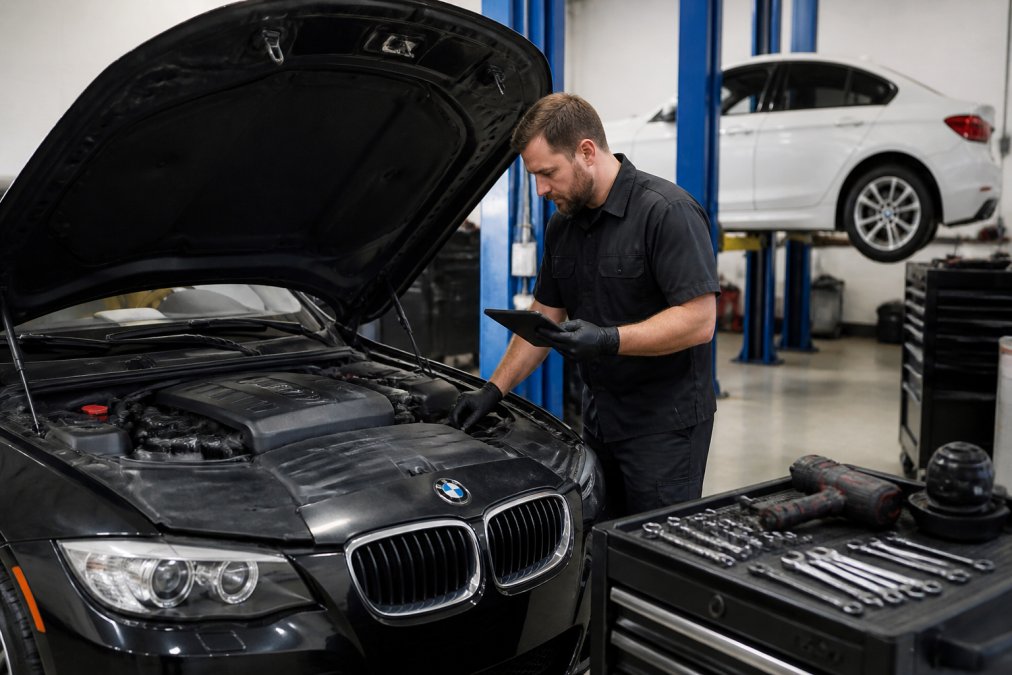
BMW repair in Boynton Beach tends to cluster around a handful of predictable issues: cooling system failures, oil filter housing gaskets, worn suspension bushings, and ignition coil faults that trigger a check engine light. None of these are exotic. They are simply the parts that age first on these cars. Maintaining the exterior finish requires similar diligence, as applying ceramic coating for cars protects the paint from the harsh Florida sun that often accelerates the degradation of these mechanical components.
Why an ASE Certified European Mechanic Matters
An ASE certified European mechanic has passed independent testing on the systems your car relies on, and that credential separates guesswork from diagnosis. ASE certification is a national standard, and it signals a technician who has been tested on brakes, electrical systems, engine performance, and more.
Dealer-Level Diagnostics vs. Generic Scan Tools
Generic scan tools read codes. Dealer-level diagnostics read the data behind those codes, including live sensor values, module communication, and freeze-frame conditions. The difference shows up when a check engine light has three possible causes and only one is correct.
Brakes, Suspension, and AC Repair: What European Cars Need
Brake system repair, steering and suspension work, and AC repair are the three service areas where European cars diverge most from domestic and Asian vehicles. European brake systems often use softer, higher-performance pad compounds that stop harder but wear faster, and their suspension geometry is tuned for handling that punishes worn components.
- Brakes: Complete maintenance and cleaning, with labor-only options if you supply your own pads
- Suspension and alignment: Control arms, bushings, and struts inspected for play and uneven tire wear
- AC repair: Refrigerant leaks and compressor faults diagnosed before summer heat exposes them
Independent Shop vs. Dealership: A Cost and Convenience Comparison
The independent-versus-dealership decision comes down to four things: diagnostics capability, scheduling, communication, and how transparent the shop is about what you are paying for. A dealership offers brand-specific tooling and a waiting room. An independent European specialist offers the same diagnostic depth with faster scheduling and more direct communication.
|
Factor |
Independent European Shop |
Dealership |
|---|---|---|
|
Scheduling |
Often same-day |
Frequently days out |
|
Diagnostics |
Dealer-level equipment |
Dealer-level equipment |
|
Communication |
Direct with the technician |
Through a service advisor |
|
Parts |
OEM or OEM-spec |
OEM only |
|
Convenience |
Pick-up and drop-off available |
Usually drop-off only |
|
Warranty |
Parts and labor warranty |
Parts and labor warranty |
|
Upsell pressure |
Service built around your inspection |
Service menus and recommended add-ons |
What Actually Drives the Cost Difference
Most dealership service departments carry higher overhead, larger facilities, manufacturer-mandated equipment, and layered service-advisor staffing. Independent European shops run leaner, which is why labor rates and total repair tickets tend to be lower for the same job. The parts themselves are often identical: many independent shops install OEM parts or OEM-spec equivalents from the same suppliers the dealer uses.
Tires Sales / install and Balance →
How to Compare Any Two Shops Before You Commit
Before you hand over the keys, ask these questions of any shop, independent or dealer:
- What diagnostic equipment do you use? The answer should include factory-level or dealer-equivalent scan tools, not a generic OBD-II reader.
- Will I get a written estimate before work begins? A reputable shop will not start a repair without your approval.
- Can I see the failed part? Any reputable facility will hand over the old parts on request.
- What does the warranty cover, parts, labor, or both? Get it in writing.
- Who actually works on my car? At a family-owned shop, you usually know the technician by name.
Why Boynton Beach Owners Choose an Independent European Specialist
A dealership is built to service every model the brand sells. An independent European shop is built to service the specific platforms that come through its bay every day, BMW N-series and B-series engines, Audi and Volkswagen EA888 four-cylinders, Porsche flat-sixes. That focus shows up in faster diagnosis, more accurate estimates, and a technician who has seen your exact failure mode before.
Frequently Asked Questions
Why do European vehicles require specialized auto repair services?
European vehicles like BMW, Audi, Porsche, and Volkswagen use proprietary diagnostic systems, tighter tolerances, and complex electronic modules that generic scan tools cannot read. An ASE certified European mechanic has factory-level training and equipment to properly diagnose check engine lights, drivability issues, and performance problems. Using a shop without this expertise often leads to misdiagnosis, unnecessary parts replacement, and repeat repairs.
What are the common maintenance intervals for BMW and Audi vehicles?
Most BMW and Audi models call for full synthetic oil changes every 7,500 to 10,000 miles, brake fluid flushes every two years, and coolant service around 50,000 miles. Spark plugs typically last 40,000 to 60,000 miles depending on the engine. Following a European car maintenance schedule rather than waiting for warning lights helps prevent costly breakdowns and keeps your warranty-compliant service records intact.
Is it necessary to use OEM parts for European vehicle repairs?
OEM parts guarantee factory fit and performance, which matters most for sensors, electronic components, and brake systems on European cars. High-quality OEM-equivalent parts can work for some applications, but your mechanic should explain the trade-offs. At a shop specializing in luxury import repair, the team can recommend the right part for your specific make, model, and driving conditions.
What is the benefit of choosing a family-owned auto shop in Boynton Beach?
Family-owned shops like CJ Auto Services LLC offer transparent pricing, honest recommendations, and a level of accountability that chain stores often lack. You deal directly with the owners, get clear explanations before work begins, and benefit from services like free vehicle pick-up and drop-off. ASE certified mechanics and a 100% parts and labor warranty mean your European auto service is backed by people who stand behind their work.



2 thoughts on “European Auto Service Near Me: Boynton Beach Guide”
Comments are closed.