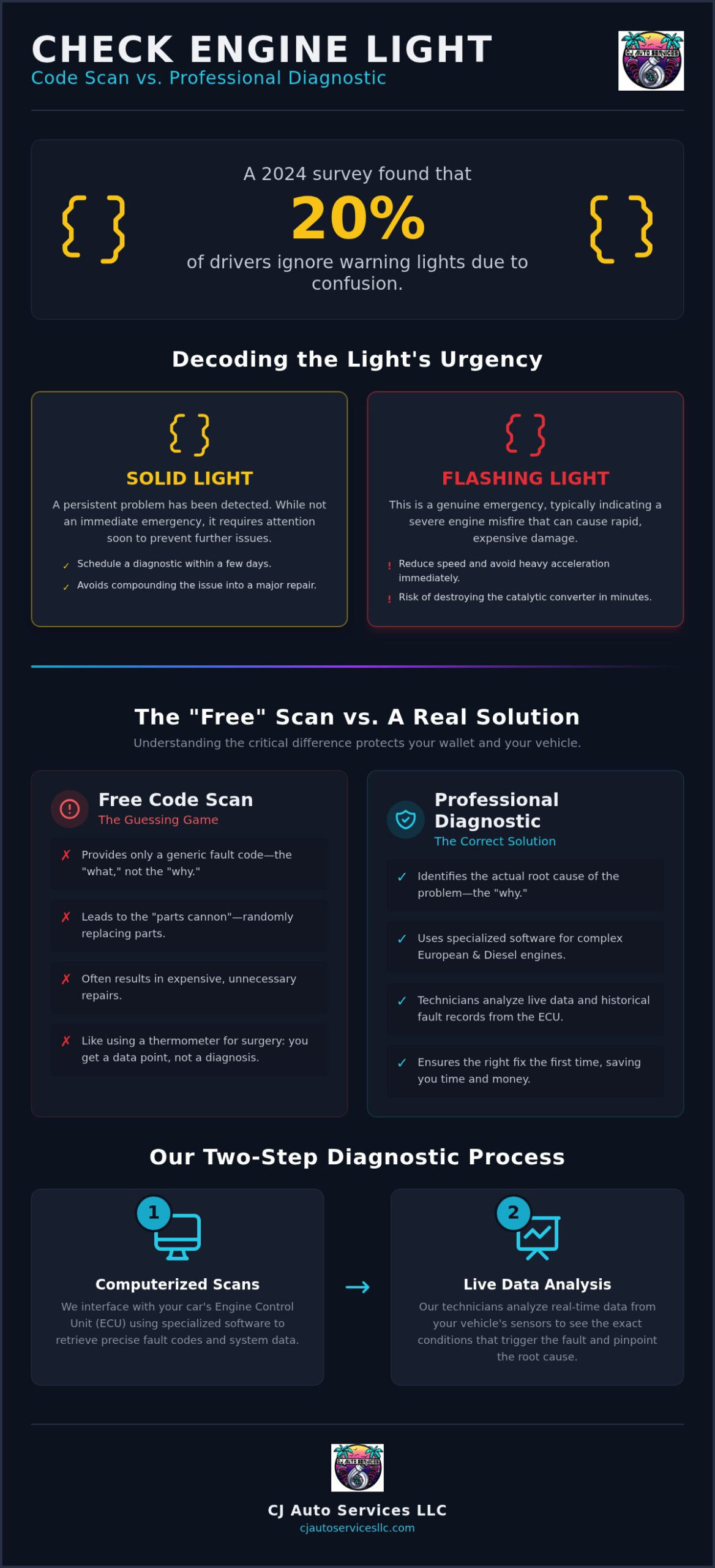
That free code scan at the local parts store might actually be the most expensive “deal” you ever find. While it is tempting to think a simple handheld reader has all the answers, a single fault code can point to a dozen different mechanical failures. If you are searching for a reliable check engine light diagnostic in Boynton Beach, you need more than just a clue; you need a solution. It is natural to feel a sense of dread about unnecessary repairs or “parts cannon” guessing when that orange glow appears on your dashboard, especially since a 2024 survey found that 20% of drivers are currently ignoring their warning lights due to confusion.
We understand how frustrating it is when an intermittent light disappears only to return a week later. In this article, you will discover why a professional diagnostic is the only way to get a clear, honest answer about your car’s health. We will explore the difference between a basic code reading and the computerized engine diagnostics required for modern European and Japanese vehicles. By the end, you will know exactly how to move from confusion to total confidence in your vehicle’s reliability and your own peace of mind.
Key Takeaways
- Learn why a basic code scan only provides a clue while a professional check engine light diagnostic identifies the actual root cause of the problem.
- Stop wasting money on the “parts cannon” by understanding why guessing based on a simple fault code often leads to expensive, unnecessary repairs.
- Find out why specialized software is essential for European and Diesel models to handle the complexity of variable valve timing and advanced sensor systems.
- Follow a clear, two-step process involving computerized scans and live data analysis to restore your car’s reliability and performance.
- Protect your vehicle’s long-term health by learning how ignoring small warning signs can lead to major failures in your exhaust and engine systems.
Understanding Your Check Engine Light: More Than Just an Icon
That small, amber light on your dashboard is often the start of a stressful day. It is technically called the Malfunction Indicator Lamp (MIL), and it serves as your vehicle’s primary way of communicating a detected fault. Modern cars are essentially rolling computers. When a sensor detects a reading outside of factory specifications, the light triggers to warn you before a minor hiccup becomes a major breakdown. This communication is made possible through On-board diagnostics (OBD-II), which is a standardized digital language that allows technicians to interface with your car’s internal systems. A professional check engine light diagnostic is more than just reading a number; it is about interpreting what the car is trying to say about its long-term health.
Modern sensors are designed to be hyper-sensitive. They can detect a loose gas cap or a microscopic vacuum leak long before you feel a change in how the car drives. While this might feel like an annoyance, early action is your best defense against expensive engine repairs. Ignoring the light doesn’t make the problem go away. It usually just gives the issue time to damage other components. Taking care of it early provides the peace of mind that comes from knowing your vehicle is safe for your family and reliable for your commute.
Solid vs. Flashing: Identifying the Urgency
The behavior of the light tells you how quickly you need to act. A solid light means the system has detected a persistent problem that needs attention soon. You don’t necessarily need to pull over immediately, but you should schedule a check engine light diagnostic within a few days to avoid compounding the issue. However, a flashing light is a genuine emergency. This usually indicates a severe engine misfire. If you keep driving with a flashing light, unburned fuel can enter the exhaust system and destroy your catalytic converter in minutes. If the light starts blinking, reduce your speed, avoid heavy acceleration, and seek professional help right away to prevent a catastrophic failure.
The Role of the Engine Control Unit (ECU)
Think of the Engine Control Unit (ECU) as the brain of your car. It monitors hundreds of parameters every second, from air intake temperature to fuel trim levels. Sometimes, the ECU records “ghost codes,” which are temporary glitches caused by a sudden change in humidity or a one-time sensor error. A master technician doesn’t just clear these codes and send you on your way. They look at the historical data stored in the car’s computer to see the exact conditions present when the fault occurred. This historical context is vital. It helps distinguish between a failing sensor and a deeper mechanical issue, ensuring we fix the problem right the first time without guessing.
Code Scanning vs. Professional Diagnostic: Why “Free” Isn’t Always Enough
It is easy to see the appeal of a free code scan. Most national auto parts chains offer them, and they seem like a quick way to solve a dashboard mystery. However, there’s a significant gap between a code and a cure. A basic handheld scanner tells you the “what,” such as a code for a lean fuel mixture. A professional check engine light diagnostic tells you the “why,” which could be anything from a cracked intake boot to a failing fuel pump. Without that deeper look, you risk firing the “parts cannon.” This is the expensive habit of replacing components one by one until the light finally stays off, often costing you more than the correct repair would have in the first place.
Relying on a cheap handheld tool to diagnose a complex modern engine is like using a thermometer to perform surgery. While the tool gives you a data point, it doesn’t provide the context needed for a permanent fix. Some drivers try to bypass the repair entirely by simply clearing the light to pass an inspection or quiet the alarm. As noted in advice from Car and Driver, resetting the light without addressing the underlying fault is only a temporary mask. The computer will eventually re-run its self-tests, find the same error, and trigger the warning again, often at the most inconvenient moment possible.
The Problem with “Code Pulling”
A common mistake happens when a code points to a specific part, like an Oxygen (O2) sensor. A parts store employee might suggest buying a new sensor immediately because the code mentions it. In reality, that sensor might be perfectly healthy but reporting a problem caused by a vacuum leak or a bad fuel injector elsewhere in the system. Retail staff aren’t trained in root-cause analysis, so they can’t see the full picture. This often leads to customers spending hundreds on parts they never actually needed. If you want to avoid this frustration, starting with computerized engine diagnostics ensures you only pay for what is actually broken.
The Value of Professional Diagnostic Testing
Professional testing involves looking at the live data stream while the engine is running. This allows a technician to see how different systems interact under real-world load conditions. We don’t just trust the computer; we verify its findings using manual tools like smoke machines to find leaks or pressure gauges to check fuel delivery. This methodical approach is what creates a “one-and-done” repair experience. It saves you time, prevents repeat visits to the shop, and restores your vehicle’s reliability with total accuracy. A check engine light diagnostic is an investment in the long-term health of your car, providing the peace of mind that comes from a job done right.
Common Culprits Behind the Light in Boynton Beach
The check engine light can stem from dozens of different issues. In our experience providing a check engine light diagnostic in Boynton Beach, we see certain patterns emerge more often than others. The most frequent visitor is the Oxygen (O2) sensor. These sensors monitor how much unburned oxygen is in the exhaust. When they fail, your fuel economy can drop significantly. Even worse, if you ignore a bad O2 sensor, it eventually causes your catalytic converter to overheat and fail. Since a catalytic converter is one of the most expensive parts of your exhaust system, catching the sensor issue early saves you a significant amount of money and stress.
Another common trigger is the Evaporative Emission (EVAP) system. This system’s job is to trap gasoline vapors before they escape into the atmosphere. While a loose or cracked gas cap is the most famous cause, we often find leaking purge valves or charcoal canisters are the real culprits. Because the EVAP system is complex and spans the length of your vehicle, a professional check engine light diagnostic is necessary to find the exact leak point without replacing the whole system. This precision is what helps us get you back on the road quickly and affordably.
Ignition and Fuel System Failures
Your engine relies on a precise mix of air, fuel, and spark. If any of these are off, the computer will let you know. Worn spark plugs or failing ignition coils are prime suspects for engine misfires. These often feel like a “stutter” or hesitation when you accelerate. Similarly, clogged fuel injectors can cause a “lean” condition where the engine isn’t getting enough gas to operate efficiently. We also frequently find that a dying battery causes erratic voltage. This confuses the car’s computer and leads to “ghost” codes that don’t actually represent a mechanical failure but rather an electrical struggle.
Environmental Factors in South Florida
Living in Boynton Beach means your car faces unique stresses. Our intense South Florida heat and high humidity are brutal on automotive components. Heat accelerates the degradation of plastic vacuum lines and rubber seals. It makes them brittle and prone to cracking over time. Once a seal fails, it creates a tiny leak that triggers the light. Humidity is equally troublesome because it encourages corrosion within electrical connectors and wiring harnesses. A tiny bit of corrosion on a sensor pin can disrupt the signal to the ECU. Keeping up with full service auto repair helps us catch these environmental wear and tear issues before they leave you stranded. Regular inspections allow us to clean connectors and replace aging hoses, ensuring your vehicle stays as reliable as the day you bought it.
Specialized Diagnostics for European and Diesel Engines
Owning a high-performance European vehicle or a heavy-duty diesel truck comes with a unique set of responsibilities. While a domestic car might share a broad range of generic codes, brands like BMW, Mercedes-Benz, and Audi use proprietary communication protocols. A standard handheld tool often cannot communicate with the advanced modules that control variable valve lift sensors or intricate timing systems. If you drive one of these precision machines, a specialized check engine light diagnostic is the only way to access the manufacturer-specific data required for an accurate repair. We use the same advanced software as the dealerships to ensure your vehicle receives the expert care it deserves.
High-performance engines often store what technicians call “shadow codes.” These are hidden faults that the computer records before the light even appears on your dash. Identifying these early prevents a minor sensor drift from turning into a total engine “limp mode” situation. Our team undergoes specialized training to interpret these complex data streams. We don’t just look for a light; we look for the subtle signs of wear that could impact your car’s legendary performance and longevity.
Diesel engines operate on entirely different mechanical parameters than their gasoline counterparts. Instead of spark plugs, we monitor compression, fuel rail pressure, and complex exhaust after-treatment systems. Issues with the Diesel Particulate Filter (DPF) or the Exhaust Gas Recirculation (EGR) valve can cause a sudden, frustrating loss of power. Without the right software to monitor soot levels or turbocharger boost pressure, you are essentially guessing. Our diagnostic process targets these specific systems to keep your work truck or diesel commuter running clean and strong.
European Vehicle Electronics
Modern European cars rely on an intricate network called a CAN bus. Think of this as a high-speed internal internet for your car’s computers. A fault in the transmission or braking module can sometimes trigger an engine light due to how these systems share data. Generic scanners usually miss these deep-seated connections entirely. For owners who value precision, our European automotive repair services provide the deep-level scanning necessary to ensure every module on the network is communicating perfectly.
Diesel Diagnostic Challenges
Diesel diagnostics require looking at live data from a different perspective. We check how the turbocharger responds under various load conditions and ensure the Diesel Exhaust Fluid (DEF) system is injecting correctly. If these systems are out of balance, your fuel efficiency plummets and your engine works twice as hard as it should. We monitor these mechanical parameters in real-time to catch small imbalances before they lead to a clogged DPF or a failed turbocharger.
If your luxury car or work truck isn’t performing with its usual vigor, don’t settle for a generic guess. Schedule your computerized engine diagnostics today to get a clear, professional picture of your vehicle’s health.
The CJ Auto Diagnostic Process: Peace of Mind in Boynton Beach
We don’t believe in rushing the discovery phase of an engine issue. A thorough check engine light diagnostic follows a logical, four-step sequence to ensure your vehicle is fixed right the first time. First, we perform a comprehensive computerized scan of every control module in your car. This goes far beyond the engine to check your transmission, safety systems, and even comfort modules. Second, we conduct a live data analysis. By watching how your engine breathes and fires under various load conditions, we can see exactly where the performance drops in real-time. This is where we catch the subtle imbalances that a stationary test would miss.
Third, our master technicians perform a visual and manual inspection of the specific components flagged by the computer. We verify that a sensor is actually failing rather than just reporting a broken wire or a leaking vacuum hose nearby. Finally, we provide a clear, transparent explanation of the root cause. We want you to understand the entire repair path before any work begins. This transparency eliminates the stress of the unknown and gives you the confidence to make the best decision for your vehicle’s longevity.
Computerized Diagnostic Tools at CJ Auto
Identifying a fault is only half the battle. Finding those frustrating “intermittent” issues that seem to disappear the moment you pull into a shop is where we truly excel. We’ve invested in dealership-level software that allows us to track historical data and hidden codes that generic tools simply can’t see. This high-level technology supports our “trusted advisor” approach. We believe in explaining the “why” behind every recommendation. Our goal is to simplify the complex world of automotive electronics, making the repair process as seamless and stress-free as possible for our Boynton Beach neighbors.
Restoring Performance and Reliability
Once the check engine light diagnostic is complete, our certified technicians move quickly to restore your vehicle’s reliability. We focus on high-quality repairs that ensure your car operates at peak efficiency. While Florida doesn’t require annual smog testing, keeping your emissions systems in top shape is vital for your engine’s health and fuel economy. If your dashboard warning is actually an ABS or traction control light rather than an engine issue, our expertise in reliable brake repair ensures your safety systems are just as dependable as your motor. We take pride in being a reliable, stress-reducing partner for all your automotive needs, helping you get back on the road with total peace of mind.
Get Back on the Road with Confidence
Don’t let a mysterious dashboard symbol drain your wallet or your patience. You’ve learned that while a free scan provides a helpful starting point, only a professional check engine light diagnostic reveals the true root cause of your vehicle’s issues. Accuracy is the key to a “one-and-done” repair, especially when dealing with the intricate electrical modules of European cars or the specialized systems found in diesel engines. Guessing with the “parts cannon” only leads to frustration and wasted money.
As family-owned European and diesel specialists, we combine computerized diagnostic accuracy with the neighborly care you expect here in Boynton Beach. We take pride in serving as your trusted advisors, ensuring you never have to guess about your car’s safety or long-term reliability. Our goal is to provide a seamless, hassle-free experience that keeps your vehicle performing at its best for years to come. We value your time and your trust above all else.
Schedule Your Professional Diagnostic at CJ Auto Services today and experience the difference that expert precision makes. We look forward to helping you restore your vehicle’s health and your own peace of mind.
Frequently Asked Questions
Is it safe to drive with the check engine light on?
It is generally safe to drive to a repair shop if the light is steady, but you should pull over immediately if it begins flashing. A steady light indicates a detected fault that needs attention soon to prevent long-term damage. A flashing light signals a severe engine misfire that can quickly destroy your catalytic converter and lead to an expensive breakdown.
Can a loose gas cap really trigger the check engine light?
A loose, cracked, or poorly sealed gas cap is one of the most common reasons the light appears. The gas cap is part of your car’s evaporative emission system, which prevents gasoline vapors from escaping into the atmosphere. If the cap is not tight, the system detects a leak and triggers a fault code. Tightening the cap often clears the light after a few days of driving.
Will my car pass inspection with a check engine light on?
Your car will pass registration in Florida even if the light is on because the state does not currently require emissions testing or smog checks for vehicle registration. While there is no mandated test, it remains illegal to tamper with or disable air pollution control devices. Maintaining a healthy engine ensures your vehicle remains reliable and fuel-efficient for your daily commute.
Why did my check engine light turn off on its own?
The light may turn off if the engine control unit determines that the fault is no longer present after several successful test cycles. These are typically known as intermittent faults, often caused by temporary sensor glitches or weather changes. Even if the light disappears, a professional check engine light diagnostic can retrieve the stored history code to identify the original problem before it returns.
How much does a check engine light diagnostic cost in Boynton Beach?
The cost of a check engine light diagnostic depends on the complexity of your vehicle and the depth of testing required to find the root cause. A professional fee reflects the technician’s specialized training and the use of advanced computerized tools that move beyond basic code reading. This investment ensures an accurate repair path, saving you money by avoiding the replacement of perfectly healthy parts.
Can I reset the check engine light by disconnecting the battery?
Disconnecting the battery might clear the light temporarily, but it does not fix the actual problem. Modern vehicle computers often store fault codes in non-volatile memory, meaning the data stays even without power. Once you reconnect the battery and drive the car, the computer will re-run its self-tests, detect the same fault, and trigger the warning light again almost immediately.
Why is my check engine light on after an oil change?
If the light appears right after an oil change, it is often due to a loose oil filler cap or a disconnected sensor that was bumped during the process. In some cases, it could be a complete coincidence unrelated to the service. A quick visual inspection can usually confirm if a simple oversight during the maintenance triggered the electronic warning system.
What is the difference between a service light and a check engine light?
A service light is a pre-programmed maintenance reminder for routine tasks like oil changes, while the check engine light signals a real-time mechanical or electronic failure. The service light is usually based on mileage or time intervals set by the manufacturer. The check engine light is triggered by the car’s computer when it detects that a component is operating outside of its normal parameters.