Your vehicle left the factory with settings designed for the average driver, but you aren’t looking for an average experience. While many enthusiasts want more from their cars, there is often a lingering hesitation to explore car performance tuning due to fears of voiding warranties or causing engine damage. It’s a valid concern; you want the thrill of increased torque and sharper throttle response without sacrificing the reliability you depend on every day.
This 2026 guide is designed to unlock your car’s hidden potential with the precision of a master craftsman. We’ll cut through the confusion between basic bolt-on parts and professional engine remapping while addressing the specific needs of drivers right here in Boynton Beach. You’ll learn how to achieve a unique, personalized appearance and a noticeable boost in power while keeping your vehicle’s longevity at the forefront.
We’re going to explore the latest software-based ECU updates, the impact of high-quality suspension upgrades, and the essential maintenance steps that ensure your high-performance build remains as dependable as it is fast.
Key Takeaways
- Understand the 2026 shift toward computerized calibration, where software precision meets mechanical hardware for a seamless power boost.
- Explore the differences between Stage 1, 2, and 3 tuning to find the perfect balance of performance and reliability for your specific goals.
- Learn how to choose between coilovers and lowering springs to enhance handling and achieve a personalized, aggressive stance.
- Get the facts on car performance tuning safety, specifically how professional remapping can improve fuel efficiency while managing Florida’s intense heat.
- Discover why a diagnostic-first approach is essential for European, Japanese, and Diesel platforms to protect your vehicle’s long-term health.
What is Car Performance Tuning in 2026?
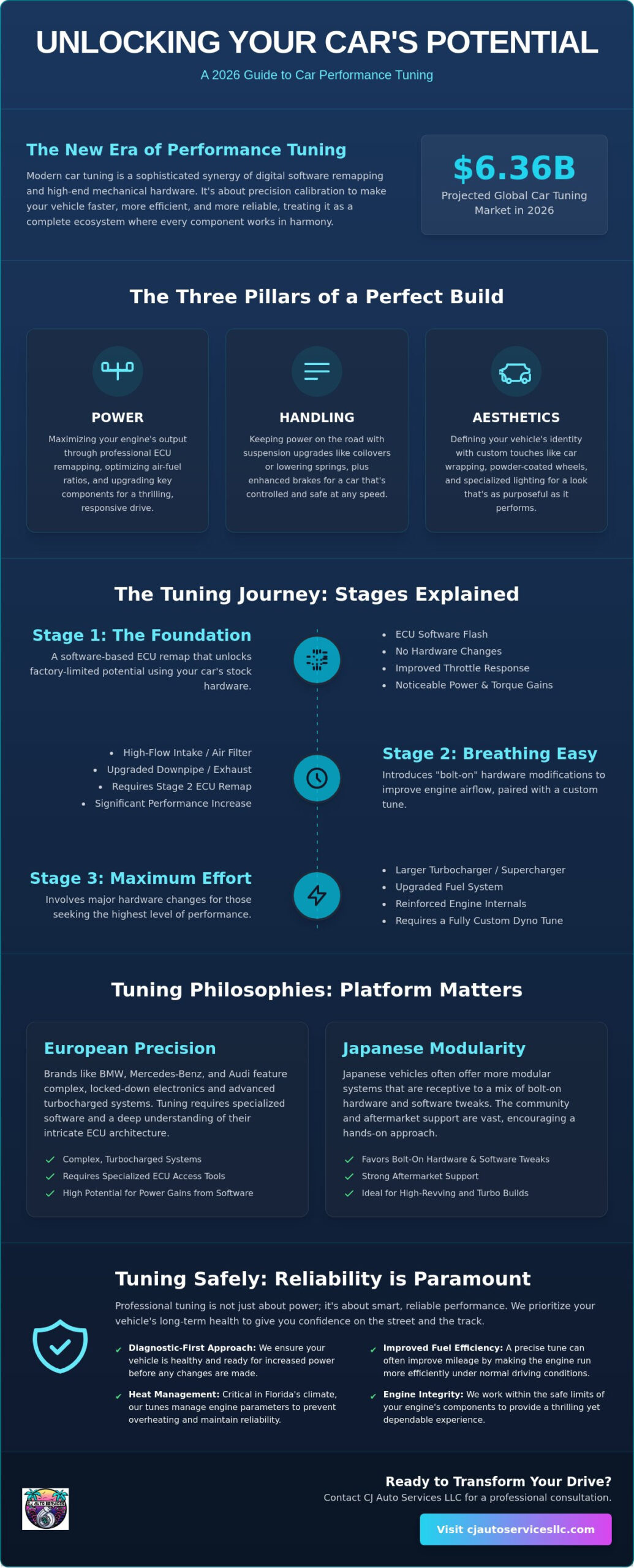
In the current automotive world, car performance tuning has evolved far beyond the greasy workshops of the past. It’s no longer just about swapping out heavy parts for lighter ones; it’s a sophisticated synergy between digital software remapping and high-end mechanical hardware. As the global car tuning market is projected to reach $6.36 billion this year, the industry has shifted toward professional, computerized calibration. This transition ensures that your vehicle isn’t just faster, but also more efficient and reliable. Modern tuning treats your car as a complete ecosystem where every adjustment to the engine’s “brain” must harmonize with the physical components under the hood.
Your vehicle’s origin plays a massive role in how we approach these upgrades. European platforms like BMW, Mercedes-Benz, and Audi often feature complex, locked-down electronic architectures that require specialized tools for ECU access. On the other hand, Japanese cars frequently offer more modular systems that favor a mix of bolt-on hardware and software tweaks. Whether you’re driving a precision-engineered German sedan or a high-revving Japanese import, your tuning roadmap must be tailored to those specific engineering philosophies to avoid unnecessary stress on the drivetrain.
The Evolution of the Tuner Scene
The days of adjusting mechanical carburetors by ear are long gone. We’ve moved into an era of sophisticated, ECU-driven performance where 46% of all tuning applications are focused specifically on the engine. For a foundational Car tuning overview, one must look at how digital tools now allow us to create “switchable” maps. This 2026 technology lets you toggle between a conservative street mode for your daily commute and a high-output track setting at the touch of a button. Before any of this magic happens, we always start with a healthy baseline. Professional engine diagnostics are the first step to ensure your vehicle is ready for the increased demands of a performance tune.
Performance vs. Aesthetic Tuning
A truly great build balances the “show” with the “go.” While it’s tempting to focus solely on raw horsepower, adding massive torque without upgrading your brakes and suspension can lead to a car that’s difficult to control. We view car performance tuning through three essential pillars: power, handling, and aesthetics. While engine remapping provides the thrill, aesthetic modifications like car wrapping and custom lighting define your vehicle’s identity. Using high-quality powder coating on wheels or specialized lift kits for suspension ensures that your car looks as purposeful as it performs. This holistic approach creates a personalized vehicle that feels cohesive, safe, and uniquely yours.
Engine and ECU Tuning: Maximising Your Power Plant
Your car’s Engine Control Unit (ECU) acts as the brain of the vehicle, managing everything from ignition timing to fuel delivery. Manufacturers typically program these computers with a conservative “one-size-fits-all” map to account for poor fuel quality or neglected maintenance in various global markets. Through professional car performance tuning, we can tap into these hidden factory reserves. ECU remapping safely adjusts these parameters to provide a sharper, more responsive driving experience without compromising the core integrity of the engine.
Most enthusiasts follow a logical progression known as tuning “Stages.” Stage 1 is primarily a software-based flash that works with your stock hardware. Stage 2 introduces basic breathing modifications, such as a high-flow intake or downpipe, to help the engine move air more efficiently. Stage 3 involves significant hardware upgrades, including larger turbochargers or reinforced internal components. Throughout this process, maintaining a precise air-fuel ratio (AFR) is vital. If the mixture is too lean, you risk catastrophic heat damage; if it’s too rich, you lose power and waste fuel. Precision calibration ensures your engine remains reliable for years to come.
High-output V8s and LS engines respond exceptionally well to timing adjustments and intake manifold upgrades, often seeing dramatic gains in both torque and peak horsepower. Similarly, diesel platforms benefit immensely from remapping. A well-tuned diesel engine provides the massive low-end torque required for effortless towing, often improving fuel economy by reducing the strain on the engine during heavy hauls.
European vs. Japanese Engine Calibration
European vehicles from brands like BMW, Mercedes-Benz, and Audi utilize highly complex, turbocharged systems that require specialized software for successful calibration. These platforms often have “torque-model” based ECUs that are far more sensitive to changes than traditional systems. In contrast, Japanese performance engines often favor high-revving characteristics that demand precise cam timing adjustments to maximize the power band. Because of these technical differences, it is essential to use a dedicated foreign car service that understands the specific digital architecture of your vehicle’s origin.
The Role of Dyno Tuning
While some people rely on a “butt-dyno” to feel the difference, real-world data logging is the only way to ensure your car is performing safely. A Dynamometer measures the actual torque and horsepower produced at the wheels, allowing a tuner to spot dangerous lean spikes or ignition knock that you can’t hear from the driver’s seat. While we focus on the engine’s output, it’s worth remembering that increased power puts more stress on your chassis. Resources like this guide to automotive dampers explained can help you understand how your suspension manages that extra energy. Ultimately, dyno tuning is the only way to verify safe power gains. If you’re ready to see what your vehicle is truly capable of, consider starting with a professional engine health check to ensure a solid foundation for your build.
Suspension and Handling: Keeping the Power on the Road
Adding raw horsepower is only half the battle. If your vehicle can’t effectively transfer that energy to the pavement, you’re simply spinning your tires. Suspension is often the most underrated aspect of car performance tuning, yet it defines how your car feels in every corner and under every heavy acceleration. A well-sorted chassis ensures that your tires maintain a consistent contact patch with the road, providing the stability you need to enjoy your new power safely and predictably.
For drivers navigating the flat, straight stretches of Boynton Beach, choosing the right “drop” is a balance of style and utility. Lowering springs provide a cost-effective way to reduce wheel gap and lower the center of gravity, which helps reduce body roll. However, if you want total control, coilovers are the superior choice. They allow for precise height adjustments and corner balancing, letting you fine-tune your ride quality for either a comfortable daily commute or a focused track day. Beyond the springs, upgrading your bushings and sway bars can significantly flatten your cornering, making the car feel much more “planted” and responsive to your steering inputs.
As you increase your vehicle’s speed, your demand for stopping power grows proportionally. Standard brake repair often evolves into a full performance upgrade once tuning begins. High-performance pads, braided stainless steel lines, and larger rotors are essential for managing the increased heat and kinetic energy of a tuned machine. It’s about ensuring your car stops as confidently as it goes.
Lift Kits and Off-Road Performance
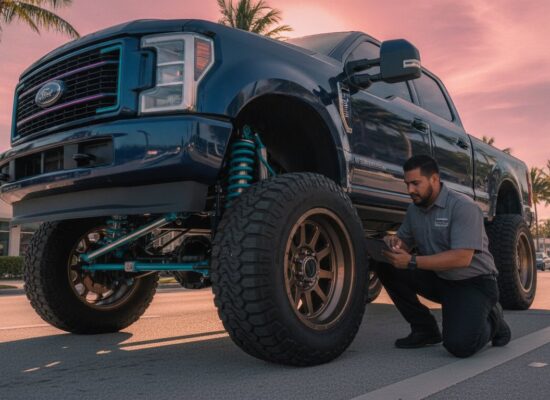
Performance tuning isn’t reserved for sports cars. For truck enthusiasts, a high-quality lift kit improves ground clearance and suspension travel for off-road adventures. While a simple leveling kit can fix a factory “rake” and allow for larger tires, a full performance lift system replaces key components to maintain proper steering geometry. This ensures your truck handles correctly on the highway while remaining rugged enough for the trails. It’s a master craftsman’s approach to making a large vehicle feel nimble and capable.
Aesthetic Performance: Powder Coating and Wrapping
A complete build addresses the visual identity of the vehicle alongside its mechanical prowess. Powder coating your wheels and brake calipers provides a durable, heat-resistant finish that stands up to the high temperatures generated during spirited driving. To protect your investment, car wrapping offers a way to completely change your car’s persona while shielding the original paint from road debris and Florida’s intense UV rays. When you add custom lighting to the mix, you create a unique “night presence” that makes your performance build stand out long after the sun goes down.
Is Performance Tuning Safe for Your Daily Driver?
Many drivers worry that modifying their vehicle is a shortcut to a blown engine or a voided warranty. This is the “reliability myth” that often keeps enthusiasts from enjoying their cars. In reality, car performance tuning can actually improve the longevity and efficiency of your engine when handled by a professional. Statistics show that roughly 52% of tuning activities are now focused on improving fuel efficiency rather than just chasing raw speed. By optimizing the air-fuel ratio and ignition timing, a conservative tune makes your engine work smarter, not harder, during your daily commute.
Living in Boynton Beach adds a specific challenge: the Florida factor. Our intense humidity and high ambient temperatures can lead to “heat soak,” where the engine loses power because it can’t stay cool. A daily driver in this climate needs a tune that accounts for these environmental stressors. We use advanced computerized diagnostics to monitor how your vehicle handles the heat, ensuring the calibration stays within safe operational limits even on the hottest July afternoons. Because a tuned engine often runs at higher internal pressures, sticking to a strict automotive oil change schedule is the best way to protect your investment. High-quality synthetic fluids help dissipate heat and maintain lubrication under the increased loads of a performance build.
Preventative Maintenance for Tuned Vehicles
When you increase power, your maintenance needs become more precise. Spark plug gaps matter significantly more on a tuned engine; a gap that’s too wide can cause a misfire under high boost. We often recommend upgrading to colder heat-range plugs and high-output coil packs to ensure a consistent spark. Cooling system upgrades, such as high-efficiency radiators or larger intercoolers, are also essential for managing Florida’s climate. Don’t forget the drivetrain. Regular transmission flushes are vital to help your gearbox handle the extra torque safely without premature wear.
Legal and Warranty Considerations
Understanding your rights is key to a stress-free experience. The Magnuson-Moss Warranty Act generally protects consumers by requiring dealers to prove that an aftermarket part actually caused a failure before denying a warranty claim. However, emissions compliance remains a top priority. In 2026, staying “street-legal” means ensuring your car performance tuning respects local regulations, such as the 95-decibel noise cap and emissions standards. Professional tuning prioritizes safety margins over “max” power. If you want to ensure your vehicle stays reliable and legal, schedule a performance health check with our team today to get a baseline for your project.
Professional Tuning at CJ Auto Services LLC
Choosing a partner for car performance tuning is a decision built on trust and technical confidence. In Boynton Beach, we’ve built our reputation by treating every vehicle with the precision of a master craftsman and the care of a neighbor. We don’t believe in generic, one-size-fits-all solutions. Instead, our process begins with a comprehensive computerized health check. This diagnostic-first approach ensures that your European, Japanese, or Diesel platform is mechanically sound before we ever touch the software. It’s about giving you peace of mind while you enjoy your car’s new power and precision.
Our facility is a one-stop destination for both performance and aesthetics. Whether you’re looking for a Stage 1 ECU remap or a full suspension overhaul with high-performance lift kits, we have the specialized tools to execute the job correctly. Local drivers trust us because we balance the thrill of modifications with the necessity of routine maintenance. We understand that a high-performance machine in Florida’s demanding climate requires a higher standard of care, and we’re here to provide it. From fluid flushes to powder coating, we handle the details that make a vehicle truly unique.
Our Performance Divisions
To provide the best results, we’ve organized our expertise into dedicated divisions. The Tuning Division focuses on advanced software calibration and LS engine expertise, delivering the torque and horsepower gains you crave. For those who want their car to look as fast as it feels, our Customization Division handles professional car wrapping and custom lighting. Finally, the Mechanical Division ensures that the core of your vehicle remains healthy. Whether it is a complex engine build or a precise Audi AC repair, we make sure every system works in perfect harmony with your new upgrades.
Get Started with Your Performance Build
Starting your build is a simple, stress-free process. We recommend scheduling a performance consultation so we can discuss your specific goals, budget, and driving style. When you arrive for your first tuning session, please bring any records of recent maintenance or previous modifications. This information helps us build a safe and effective roadmap for your vehicle. You can contact CJ Auto Services LLC for a custom quote today. We’re ready to help you transform your vehicle into the personalized machine you’ve always wanted while ensuring it stays reliable for the long haul.
Ready to Redefine Your Driving Experience?
Modern car performance tuning is about more than just numbers on a dyno; it’s the art of perfecting your vehicle’s unique personality. You’ve seen how precise ECU remapping can unlock hidden power, while professional suspension upgrades keep that energy firmly on the road. By prioritizing computerized diagnostics and preventative maintenance, you can enjoy these gains without sacrificing the reliability of your daily driver. It’s a balance of power and precision that makes every drive more engaging.
At CJ Auto Services LLC, we bring a master craftsman’s touch to every project. Since 2022, our family-owned shop in Boynton Beach has served as a trusted partner for local enthusiasts. Our specialists have the expertise to handle BMW, Mercedes, Audi, and Japanese imports with the care they deserve. Whether you’re visiting us for a routine oil change or a full-scale customization build, we’re here to help you navigate the complexities of modern modifications while keeping your car safe and efficient.
Take the first step toward a more responsive, personalized ride today. Book Your Performance Consultation at CJ Auto Services and let’s discuss the vision for your build. Your vehicle has untapped potential, and we’re excited to help you find it.
Frequently Asked Questions
Will performance tuning void my factory warranty?
Tuning your car doesn’t automatically void your entire warranty, but it can lead to a denied claim if a specific failure is directly caused by the modification. Under the Magnuson-Moss Warranty Act, a dealer must prove the tune caused the issue before refusing coverage. It’s always best to be transparent with your service advisor and choose conservative calibrations that stay within factory safety limits to maintain your peace of mind.
How much horsepower can I expect from a Stage 1 tune?
You can generally expect a horsepower increase of 10% to 25% with a Stage 1 car performance tuning setup. These gains vary significantly based on whether your engine is naturally aspirated or turbocharged. For example, turbocharged European cars often see higher percentage jumps because the software can safely increase boost pressure. This entry-level modification provides a noticeable difference in throttle response without requiring expensive hardware changes.
Does ECU tuning decrease the lifespan of my engine?
ECU tuning doesn’t necessarily decrease your engine’s lifespan if the calibration respects mechanical limits. In fact, many professional tunes focus on optimizing efficiency, which can reduce internal strain during normal driving. Problems typically only arise from “max power” tunes that ignore safety margins or skip essential diagnostics. Regular maintenance and high-quality fluids are the real keys to ensuring a tuned engine lasts as long as a stock one.
Can I tune my diesel truck for better fuel economy?
Yes, diesel tuning is a highly effective way to improve fuel economy by maximizing low-end torque. When your engine produces more torque at lower RPMs, it doesn’t have to work as hard to maintain highway speeds or pull heavy loads. Many diesel owners report better miles-per-gallon after a professional remap. This makes tuning a smart investment for both performance and long-term operating costs in Florida’s demanding conditions.
What is the difference between a flash tune and a custom dyno tune?
A flash tune is a pre-written software file designed for a specific vehicle model, while a custom dyno tune is tailored to your exact car on a dynamometer. Flash tunes are convenient and cost-effective for basic builds. However, custom dyno tuning allows a specialist to account for your engine’s specific wear and environmental conditions. This personalized approach ensures the safest and most precise power delivery possible for your unique vehicle.
Are performance modifications legal for street use in Florida?
Most performance modifications are legal in Florida, as the state doesn’t currently require annual emissions testing for registration. However, you must still comply with federal EPA standards and local noise ordinances. For instance, your exhaust shouldn’t exceed the 95-decibel limit to avoid potential fines. It’s also important to ensure your suspension modifications don’t interfere with the safety systems required for modern road use.
Do I need to use premium fuel after my car is tuned?
Most performance tunes require the use of 91 or 93 octane premium fuel to prevent engine knock or detonation. High-performance software often advances ignition timing to create more power, which needs the stability of higher-octane gasoline. Using lower-grade fuel on a tuned engine can cause the ECU to pull back power to protect the hardware. Sticking to premium ensures you’re getting the full benefit and safety of your car performance tuning investment.
How long does a typical performance tuning session take?
A typical tuning session usually takes between two and six hours, depending on the complexity of the project. A simple Stage 1 software flash might be completed quickly, while a full custom dyno session requires more time for data logging and incremental adjustments. We recommend allowing a full afternoon for your appointment. This gives our team enough time to perform a thorough diagnostic check before and after the calibration to ensure everything is perfect.