Table of Contents
- What ASE Certification Actually Means for Your Vehicle
- Types of ASE Certifications and What They Cover
- The Benefits of ASE Certified Auto Repair
- ASE Blue Seal of Excellence: What It Means for a Shop
- How to Check Mechanic Certification Before You Commit
- Common Services ASE Certified Mechanics Perform
- Conclusion
Last Updated: August 12, 2026
What ASE Certification Actually Means for Your Vehicle
ASE certification is a professional credential issued by the National Institute for Automotive Service Excellence, the independent non-profit organization that sets the technical benchmark for automotive repair in the United States. To earn certification, a technician must pass a rigorous written exam covering a specific area of vehicle repair and demonstrate at least two years of hands-on work experience in that field.
That combination matters. A written test alone doesn’t prove a technician can fix your car. Work experience alone doesn’t prove they understand the underlying systems. ASE requires both, which is why the credential carries real weight with vehicle owners and fleet operators alike.
At CJ Auto Services LLC, every technician on the floor holds active ASE credentials, which means the person diagnosing your vehicle has been independently verified, not just self-described as "experienced." For vehicle owners who’ve been burned by shops that charged for work that never happened, that independent verification is the difference between trust and guesswork.
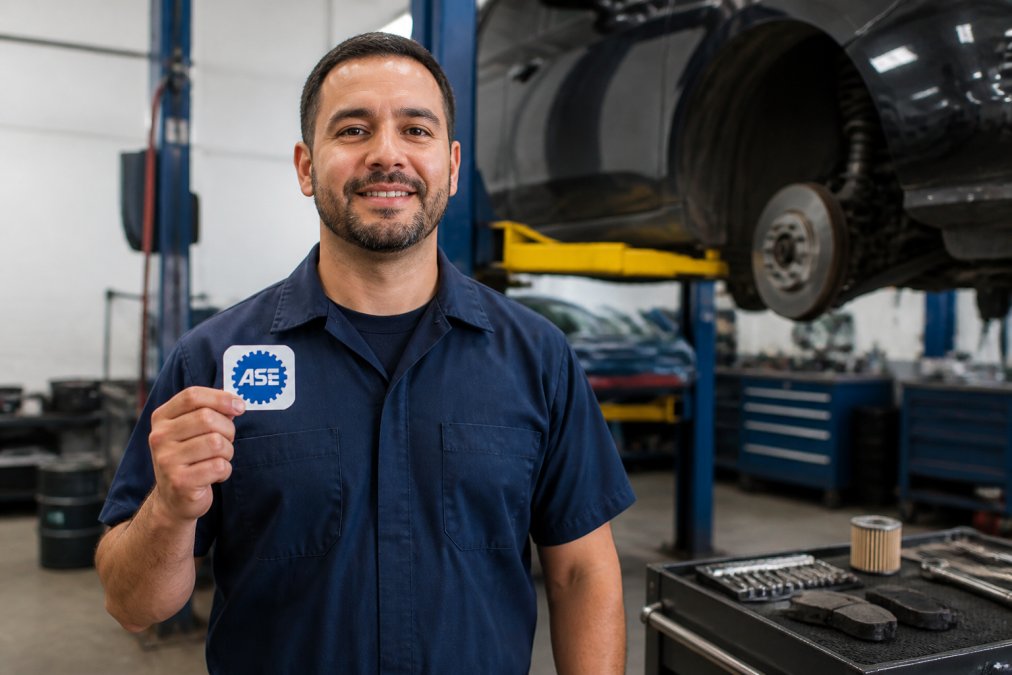
According to the National Institute for Automotive Service Excellence, there are currently more than 300,000 ASE-certified professionals working across the country, covering everything from passenger vehicles to heavy-duty diesel equipment. That number sounds large until you consider how many repair shops operate without a single certified technician on staff.
How Technicians Earn and Maintain Their Certification
Earning ASE certification isn’t a one-time event. Certified technicians must recertify every five years by retesting, which ensures their knowledge stays current as vehicle technology evolves. Modern vehicles with advanced driver-assistance systems, hybrid powertrains, and complex electrical architectures require a fundamentally different skill set than vehicles from a decade ago. A technician who passed an exam in 2016 and never updated their credentials is working with outdated knowledge.
The recertification requirement is one of the most underappreciated aspects of the credential. It’s not just about holding a certificate. It’s about maintaining diagnostic accuracy as the industry changes.
Master Technician Status: What Sets It Apart
A Master Technician is an ASE-certified professional who has passed all exams within a specific series, typically the Automobile series covering eight areas: engine repair, automatic transmission, manual drivetrain, suspension and steering, brakes, electrical systems, heating and air conditioning, and engine performance.
Most certified technicians hold credentials in one or two specialty areas. A Master Technician has demonstrated competency across the entire vehicle. For complex diagnostic work where a symptom in one system affects another, that breadth of knowledge translates directly into faster, more accurate repairs.
When calling a shop, ask specifically how many of their technicians hold Master Technician status, not just how many are “ASE certified.” The distinction tells you a lot about the shop’s overall technical depth.
Types of ASE Certifications and What They Cover
ASE certification spans multiple series, each targeting a distinct segment of the automotive industry. The most common is the Automobile series, but the credential goes well beyond passenger cars.
| ASE Series | Coverage Area | Best For |
|---|---|---|
| Automobile (A1-A8) | Engine, brakes, electrical, HVAC, suspension | Passenger vehicles, SUVs |
| Medium/Heavy Truck (T1-T8) | Diesel engines, drivetrain, brakes | Commercial trucks, fleet vehicles |
| Collision Repair (B2-B5) | Structural repair, refinishing, non-structural damage | Post-accident bodywork |
| Advanced Level (L1-L3) | Hybrid/EV, advanced diagnostics, engine performance | Modern complex vehicles |
| Undercar Specialist (X1) | Exhaust systems | Specialty exhaust work |
| Parts Specialist (P2) | Parts identification and sourcing | Parts counter professionals |
The Advanced Level certifications are worth highlighting. The L1 and L2 exams cover advanced engine performance and electronic diesel engine diagnosis, areas where many general repair shops lack depth. If you drive a hybrid, a diesel truck, or a vehicle with complex onboard electronics, asking whether a shop holds Advanced Level credentials is a reasonable question.
Specialized Areas: Diesel, Electrical, and Collision Repair
Diesel vehicles operate under fundamentally different engineering principles than gasoline engines, and a technician without specific diesel training can cause expensive damage through misdiagnosis. The ASE Medium/Heavy Truck series addresses this directly, covering diesel engine systems, fuel injection, and emissions controls.
Electrical systems certification has become increasingly critical. Modern vehicles can carry dozens of networked control modules, and a fault in one can produce symptoms that appear in a completely unrelated system. A technician with electrical systems credentials understands how to trace faults through a vehicle’s network rather than replacing parts until the problem disappears.
Collision repair certification covers structural and non-structural damage assessment, welding, and refinishing. This is a separate credential track from mechanical repair, and a shop that handles both should hold certifications in both areas.
The Benefits of ASE Certified Auto Repair
Choosing a shop staffed with ASE certified mechanics reduces the risk of misdiagnosis, unnecessary repairs, and repeat visits for the same problem. The practical benefits come down to three things: technical accuracy, accountability, and recourse.
Technical accuracy means the technician identifying your problem has been tested on the relevant systems. Accountability means the certification is tied to a professional record, not just a business name. Recourse means you have a verifiable credential to reference if something goes wrong.
Many vehicle owners report that shops with certified technicians communicate more clearly about what’s wrong and why a specific repair is needed. That transparency is partly a function of training: a technician who understands a system can explain it. A technician who’s guessing tends to stay vague.
The clearest signal of a trustworthy shop isn’t the waiting room or the signage. It’s whether the technician can explain your repair in plain terms before they start it.
Cost-Benefit Reality: Certified vs. Non-Certified Shops
The honest answer on cost is that certified shops aren’t always more expensive, and even when they are, the math often favors them. A misdiagnosis at a non-certified shop that results in replacing the wrong part costs more than a correct diagnosis the first time. Repeat visits for the same unresolved problem add up quickly.
For vehicle owners relying on their car for work, the cost of downtime needs to factor into the calculation. A repair that takes three days at a cheaper shop versus one day at a certified shop isn’t actually cheaper if you’re missing work or renting a vehicle in the gap.
That said, certification alone doesn’t guarantee fair pricing. Always ask for a written estimate before authorizing any work. Shops with genuine confidence in their technicians will provide one without hesitation.
ASE Blue Seal of Excellence: What It Means for a Shop
The ASE Blue Seal of Excellence is a shop-level recognition awarded to repair facilities where at least 75% of the technicians performing repairs are ASE certified and the shop employs at least one ASE-certified technician in each area of service it offers.
The distinction between an individual certification and the Blue Seal matters. A single certified technician in a ten-person shop means nine people working on your vehicle may hold no credentials at all. The Blue Seal requirement ensures that certification is the norm at a shop, not the exception.
According to ASE’s official Blue Seal program criteria, shops must apply for the recognition and renew it regularly, which creates ongoing accountability rather than a one-time designation. For vehicle owners, spotting the Blue Seal emblem at a repair facility is a reliable shortcut for evaluating overall shop quality without interviewing every technician individually.
The Blue Seal also signals something about shop culture. Shops that invest in getting their entire team certified are making a deliberate commitment to technical proficiency. That investment tends to show up in how they handle customer communication, warranty disputes, and quality assurance.
How to Check Mechanic Certification Before You Commit
Verifying a mechanic’s credentials takes less than five minutes and is one of the most useful things you can do before authorizing a repair. Here’s the process:
- Ask directly. Request the technician’s ASE certification number and the specific areas they’re certified in. A legitimate certified professional will have this information readily available.
- Use the ASE consumer verification tool. The ASE consumer credential lookup tool allows you to verify certification status by entering a technician’s name or certification number. This confirms the credential is current, not expired.
- Check for the Blue Seal. Look for the ASE Blue Seal of Excellence emblem displayed at the shop. Legitimate Blue Seal shops are listed in the ASE shop locator.
- Ask about recertification dates. Certifications expire every five years. A technician whose credentials lapsed two years ago and hasn’t recertified is operating on outdated qualifications.
- Request written documentation. Reputable shops will provide a written estimate and repair order that identifies which technician performed the work.
Never assume certification based on a shop’s marketing language. Terms like “trained technicians” or “experienced mechanics” carry no independent verification. Only the ASE credential is backed by a third-party exam and documented work history.
Your Rights Under State Consumer Protection Law
Vehicle owners have meaningful legal protections when it comes to auto repair. Under the FTC’s consumer protection guidelines for auto repair, repair shops are required to provide a written estimate before beginning work, obtain authorization before performing repairs, and return replaced parts upon request. Many states layer additional protections on top of these federal baseline rules.
The practical implication: if a shop refuses to provide a written estimate, that’s a red flag regardless of whether they’re certified. If a shop performs unauthorized repairs and demands payment, you have grounds to dispute the charge. Knowing these rights before you walk into a shop changes the dynamic of the conversation.
Common Services ASE Certified Mechanics Perform
ASE certified mechanics handle the full range of automotive repair and preventative maintenance that keeps vehicles reliable. The most common services include:
- Engine repair and diagnostics: Identifying and resolving issues with internal combustion systems, from minor misfires to major component failures
- Brake service: Inspection, pad and rotor replacement, caliper service, and brake fluid maintenance
- Transmission service: Fluid changes, filter replacement, and diagnosis of shifting problems in both automatic and manual systems
- Electrical systems diagnosis: Tracing faults in wiring, control modules, sensors, and battery systems
- Heating and air conditioning: Refrigerant recharge, compressor diagnosis, and cabin comfort system repair
- Steering and suspension: Alignment, shock and strut replacement, and tie rod service
- Preventative maintenance: Oil changes, fluid inspections, filter replacements, and scheduled service intervals
- Engine performance tuning: Addressing issues with fuel delivery, ignition timing, and emissions systems
For diesel vehicle owners specifically, certified technicians with Medium/Heavy Truck credentials can handle diesel-specific diagnostics that general repair shops often lack the equipment and training to perform correctly.
CJ Auto Services LLC offers electronic diagnosis for $100, giving vehicle owners a complete computerized diagnostic assessment before any repair work begins. That upfront diagnostic step is how a shop demonstrates honesty: you see exactly what the vehicle’s systems are reporting before you authorize anything.
Preventative care is where certified technicians often add the most long-term value. A technician who spots a worn serpentine belt during an oil change, or notices brake fluid that’s absorbed moisture and needs flushing, is doing exactly what the certification is designed to produce: proactive identification of problems before they become expensive failures.
Finding a repair shop you can trust is genuinely difficult, especially if you’ve had a bad experience with a shop that charged for work that wasn’t done. The credential system exists precisely to give vehicle owners an independent way to evaluate technicians without having to take anyone’s word for it. CJ Auto Services LLC backs that credential with same-day appointments, free vehicle pick-up and drop-off, and a 100% parts and labor warranty, so the certification isn’t just a credential on the wall. It’s a commitment you can hold them to. Schedule Service today and find out what it’s like to work with a shop that explains the repair before they start it.
Frequently Asked Questions
Does Florida require ASE certification for mechanics?
Florida does not legally require mechanics to hold ASE certification to work on vehicles. However, the Florida Motor Vehicle Repair Act (Chapter 559, Florida Statutes) does require repair shops to provide written estimates, obtain authorization before starting work, and return replaced parts on request. ASE certification is voluntary but signals that a technician has passed nationally standardized exams and meets industry standards, making it one of the strongest indicators of technical proficiency you can look for when choosing a shop.
How do I know if a mechanic is ASE certified?
Ask the shop to show you the technician's current ASE credentials, or verify directly through the ASE website at ase.com using the shop's name or technician's information. Certified technicians carry a wallet card and receive shoulder patches. Certifications expire every five years, so confirm the credentials are current. Shops that have earned the ASE Blue Seal of Excellence display that designation prominently, which means at least 75% of their technicians hold active ASE certifications across multiple specialty areas.
What is the difference between an ASE certified mechanic and a master technician?
An ASE certified mechanic has passed at least one of ASE's specialty exams, covering areas like brake service, engine repair, or electrical systems, plus documented two years of hands-on work experience. A master technician has passed all eight ASE exams within a specific series, such as the Automobile or Medium/Heavy Truck series. Master technician status represents the highest level of ASE recognition and indicates broad diagnostic accuracy and technical proficiency across every major vehicle system.
How often do mechanics need to renew their ASE certification?
ASE certifications are valid for five years. After that, technicians must pass a recertification test to keep their credentials active. This recertification requirement ensures that certified professionals stay current with evolving vehicle technology, new automotive parts standards, and updated diagnostic procedures. When you verify a mechanic's credentials, always confirm the expiration date on their certification, an expired credential means the technician has not completed the required recertification and their status is no longer active.
Does ASE certification cover all types of vehicle repairs?
ASE offers certifications across a wide range of automotive specialties, including engine repair, transmission service, brake service, steering and suspension, heating and air conditioning, electrical systems, collision repair, and diesel engine repair. However, no single certification covers every possible repair. A master technician who has passed all exams in a series has the broadest coverage. For specialized vehicles like diesel trucks or high-performance cars, confirm the technician holds the specific ASE certification relevant to your vehicle type.
What does an electronic diagnosis cost, and why does it matter?
At CJ Auto Services LLC, a full computerized electronic diagnosis is $100. This scan reads fault codes from your vehicle's onboard systems and gives technicians a precise starting point for any repair. Skipping a proper diagnostic often leads to parts being replaced unnecessarily, which costs more over time. A thorough diagnostic is especially important for vehicles with complex electrical systems or recurring warning lights, where guesswork repairs rarely solve the root cause.
This article was written using GrandRanker