Table of Contents
- What You’ll Need Before You Pick Up Your Car
- How to Verify Mechanic Repair Work: A Step-by-Step Checklist
- How to Read an Auto Repair Invoice Line by Line
- Aftermarket vs OEM Parts for European Cars: What You Should Know
- Questions to Ask Your Mechanic After a Repair
- Common Mistakes Drivers Make When Verifying Repairs
- Conclusion
- Frequently Asked Questions
Last Updated: September 12, 2026
What You’ll Need Before You Pick Up Your Car
Knowing how to verify mechanic repair work starts before you pay the bill. At CJ Auto Services LLC in Boynton Beach, Florida, we’ve watched too many drivers accept a handshake and a set of keys without checking a single thing. That’s how people end up back on the road with a problem that was never actually fixed.
Gather these items before you walk into the shop:
- Your original written estimate or work order
- The final invoice, itemized line by line
- Your phone, charged, with the flashlight ready
- A few minutes of daylight to inspect the car outside
- Any photos you took of the vehicle before dropping it off
The Federal Trade Commission’s consumer guidance on auto repair makes one point clear: you’re entitled to a written estimate and an itemized bill. Use both.
How to Verify Mechanic Repair Work: A Step-by-Step Checklist
Verifying a repair means confirming three things: the invoice matches reality, the repaired system actually works, and nothing new broke in the process. Work through the checklist below in order, and don’t rush it.
Step 1: Match the Invoice to the Work Performed
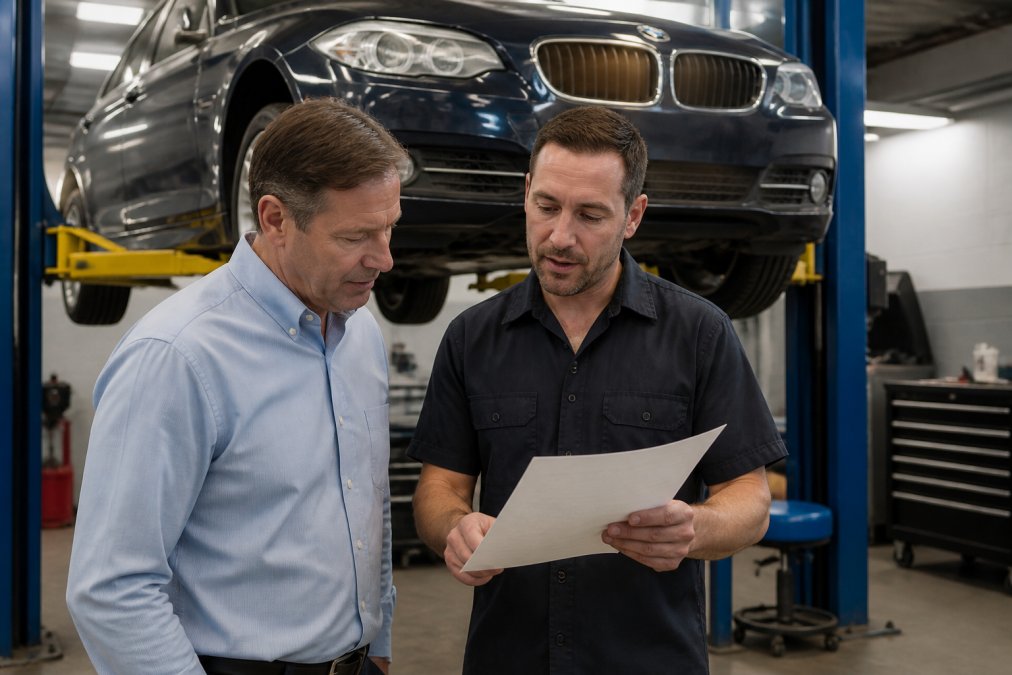
Start with the paperwork. Read every line and confirm each part number, labor hour, and fluid charge corresponds to something you approved. If your estimate covered front brake pads and rotors but the invoice adds a “brake system flush,” stop and ask why. Reputable shops call before adding work. A common mistake is signing the invoice at the counter without reading it, which makes later disputes much harder to resolve.
Step 2: Test the Specific System That Was Repaired
Drive the car before you leave the lot. If the AC was repaired, run it at full cold for several minutes and check the vent temperature by hand. If brakes were replaced, do a few low-speed stops in the parking lot and listen for grinding or squealing. For a check-engine or diagnostic repair, ask the technician to show you the scan tool reading with the light cleared (the EPA). Testing takes five minutes and catches most problems while you’re still standing in the shop.
Step 3: Look for Signs of Poor Quality Auto Repair
Walk around the vehicle with a flashlight. Look for fresh fluid drips under the car, loose or missing fasteners, scratched paint near a repaired panel, and hoses or wiring that sit differently than before. Under the hood, check that the oil cap, coolant cap, and dipstick are seated. A shop that does careful work leaves the car clean and reassembled correctly. Sloppy details on the outside usually mean sloppy work on the inside.
How to Read an Auto Repair Invoice Line by Line
An auto repair invoice should tell you exactly what was done, what parts were used, and how long the job took. If any of those three pieces is missing, ask for it before you pay.
Here’s what each section means:
- Customer concern: The symptom you described, in your words. This should match what you told the service advisor.
- Cause: What the technician found. This is the diagnosis, and it should be specific.
- Correction: The repair performed, including part numbers and labor hours.
- Parts: Each part listed separately with a number and a description. Ask whether it’s OEM or aftermarket.
- Labor: Hours billed, usually against a published labor guide. Ask to see the guide if a number looks high.
- Sublet: Work sent to another shop, such as an alignment or a machine shop service.
Compare the labor hours against the job. A brake pad replacement and a full brake job are not the same ticket, and the invoice should reflect that difference.
Aftermarket vs OEM Parts for European Cars: What You Should Know
The aftermarket vs OEM parts for European cars question matters more than it does on a domestic vehicle. OEM means Original Equipment Manufacturer: the part is made to the same specification as what came on your BMW, Audi, Porsche, or Volkswagen at the factory (nhtsa.gov). Aftermarket parts come from a third-party maker and range from excellent to unusable.
For European vehicles, fitment is the deciding factor. A cheap aftermarket sensor may bolt in but read incorrectly, which triggers a warning light and sends you back to the shop. Some European models also require programming or calibration after a part swap, and not every aftermarket component supports that.
Ask your shop these questions:
- Is this part OEM, OEM-equivalent, or a budget aftermarket option?
- Does the part carry its own warranty, separate from the labor warranty?
- Will this part require programming or relearning after installation?
Questions to Ask Your Mechanic After a Repair
Ask directly, and expect a direct answer. A shop with nothing to hide will walk you through the work without getting defensive. Here are the questions worth asking every time:
- Can you show me the old parts you replaced?
- What testing confirmed the repair is complete?
- Is there anything you noticed that isn’t urgent yet but should be watched?
- Does this repair fall under your parts and labor warranty?
- If the same symptom comes back, what’s the process?
That last question matters most. A shop that stands behind its work will tell you to bring it back and will look at it again. At CJ Auto Services LLC, every repair is backed by a 100% parts and labor warranty, so a comeback is our problem to solve, not yours. High-quality components are essential to this commitment, which is why we prioritize the process of identifying genuine parts to ensure every vehicle receives the reliable hardware it deserves.
If you’re searching for a European car service near me in Boynton Beach, ask these questions on your first visit. The answers tell you more than any review page.
Common Mistakes Drivers Make When Verifying Repairs
The biggest mistake is skipping the test drive. Drivers pick up the car, glance at the invoice, and drive home, assuming everything is fine. Then the same noise returns a week later and the shop has no way to connect it to the original job.
Other mistakes we see:
- Not keeping the estimate. Without it, you can’t tell whether the final bill grew.
- Ignoring new noises or warning lights. A light that appears right after a repair is almost always related to that repair.
- Waiting too long to call. Most warranties and goodwill policies depend on reporting a problem promptly.
- Paying before inspecting. Once you’ve paid and left, your use drops.
A short, careful inspection at pickup protects you far better than a complaint a month later.
Conclusion
Verifying repair work isn’t about distrust. It’s about confirming that the job you paid for is the job you received, and any honest shop welcomes that.
If you drive a BMW, Audi, Porsche, or Volkswagen and want a shop that shows you the diagnosis, explains the parts, and backs the work with a 100% parts and labor warranty, CJ Auto Services LLC is built for exactly that. Our ASE Certified mechanics handle diagnostics, brake repair, AC repair, suspension work, maintenance, and tune-ups, with same-day appointments and free vehicle pick-up and drop-off across Boynton Beach. If you’d rather not spend your afternoon double-checking a repair, you can Schedule Auto RepairService with CJ Auto Services LLC and pick up your car knowing exactly what was done.
Frequently Asked Questions
How do I know if my mechanic actually fixed the problem?
Start by test-driving the car on the same type of roads where you noticed the issue. If it was a brake job, listen for squealing and feel for a soft pedal. If it was an AC repair, check that cold air comes out within a few minutes. Then compare the invoice to what you were told would be done. A shop that stands behind its work, like CJ Auto Services LLC with its 100% parts and labor warranty, will not hesitate to explain exactly what was replaced and why.
What should I look for when inspecting European car repairs?
European vehicles like BMW, Audi, Porsche, and Volkswagen use specific fasteners, fluids, and diagnostic procedures. Check that the shop used the correct oil spec, that underbody panels and splash shields are reinstalled, and that no warning lights remain on the dash. Ask whether the repair required a computer relearn or calibration. If a shop cannot answer those questions for your model, that is a sign they may not work on European cars regularly.
How can I verify if aftermarket parts were used on my BMW or Audi?
Ask for the part numbers on your invoice and compare them to what the manufacturer lists for your model year. OEM parts usually carry the automaker’s logo or a branded part number, while aftermarket parts carry the manufacturer’s own brand. If the invoice does not list part numbers, request them. Reputable shops will show you the boxes or the old parts if you ask before the work starts.
What questions should I ask my mechanic after a repair is completed?
Ask four things: what exactly was replaced, whether the parts were OEM or aftermarket, what warranty covers the work, and what symptoms would tell you the problem has returned. Also ask if any related components are showing wear so you can plan ahead. A shop that gives clear, direct answers without pressure is one you can trust for future maintenance.


