Table of Contents
- Why Verifying Auto Repair Work Matters
- Review Your Auto Repair Invoice Checklist Before You Leave
- Inspect Your Vehicle for Physical Evidence of Work
- How to Test Drive After Repair
- Why ASE Certified Mechanics in Boynton Provide Verification You Can Trust
- Request Diagnostic Reports and Documentation
- What to Do If Repair Work Wasn’t Completed Properly
- Conclusion
Last Updated: August 22, 2026
Why Verifying Auto Repair Work Matters
When you drop your car off at a repair shop, you’re trusting them with one of your most valuable assets. That trust deserves verification. 🔍
Many car owners have experienced the frustration of paying for repairs only to discover the work wasn’t completed, was done incorrectly, or wasn’t done at all. This isn’t paranoia, it’s a legitimate concern that happens often enough to warrant careful attention. The stakes are real: a faulty brake repair puts you and your passengers at risk. An incomplete engine diagnostic means your underlying problem persists. An overcharged labor bill drains your wallet for work that never happened.
Verifying auto repair work completed protects your transportation investment and ensures your safety on the road. It’s not about being difficult or distrustful of your mechanic. It’s about being informed and responsible. At CJ Auto Services LLC, we encourage customers to ask questions and inspect their vehicles, transparency builds confidence, and confidence builds long-term relationships.
This guide walks you through practical, step-by-step methods to verify that the work you paid for was actually performed to standard. You’ll learn what to look for on your invoice, what physical signs indicate new parts installation, how to test drive safely after repairs, and what to do if something doesn’t add up.
Review Your Auto Repair Invoice Checklist Before You Leave
Your invoice is the paper trail of what was supposed to happen. Before you leave the repair shop, spend five minutes reviewing it carefully. This single step catches most problems before they become bigger headaches.
Check for Itemized Details
An itemized invoice breaks down each service, part, and labor charge separately. This is your first verification checkpoint.
A proper invoice should list:
- Service description: Not just "brake work" but "replace front brake pads and rotors, inspect calipers"
- Parts used: Specific part names, part numbers, and quantities (e.g., "Bosch Premium Front Brake Pads, Part #BP1234, Qty: 1 set")
- Labor hours: The actual time spent on each service (e.g., "Brake pad replacement: 1.5 hours")
- Warranty information: Coverage period for parts and labor
If your invoice reads like "Brake service, $450" with nothing else, that’s a red flag. Push back and ask for itemization. A reputable shop has no reason to hide the details.
Verify Parts Information
The parts listed on your invoice should match what the mechanic said needed replacement. Cross-reference the invoice description with what you discussed when you dropped off your vehicle.
Look specifically for:
- OEM vs. aftermarket: Did you agree to original equipment manufacturer parts or aftermarket alternatives? The invoice should match your agreement.
- Part numbers: These should be specific, not generic. A real part number looks like "BP1234-X" not just "brake pads."
- Quantity: If you authorized replacement of four tires, the invoice should list four tires, not three.
- Brand names: Quality shops use recognizable brands. If the parts listed are unfamiliar or generic-sounding, ask about them.
Many shops, including ASE certified mechanics in Boynton, provide detailed part specifications because they stand behind their work with warranty coverage. If a shop is vague about parts, that’s a signal to ask more questions.
Confirm Labor Hours and Warranty Coverage
Labor rates vary, but the hours charged should align with industry standards for that specific repair. A tire rotation shouldn’t take three hours. An engine diagnostic shouldn’t take 45 minutes unless something complex was uncovered.
Look at your warranty coverage:
- Parts warranty: How long are the new parts covered if they fail?
- Labor warranty: If the repair fails due to improper installation, will they redo the work at no charge? (This should be standard)
- Conditions: Are there any limitations? For example, some warranties exclude wear items like brake pads.
A shop offering a 100% parts and labor warranty demonstrates confidence in their work. This is the standard you should expect, not the exception.
Inspect Your Vehicle for Physical Evidence of Work
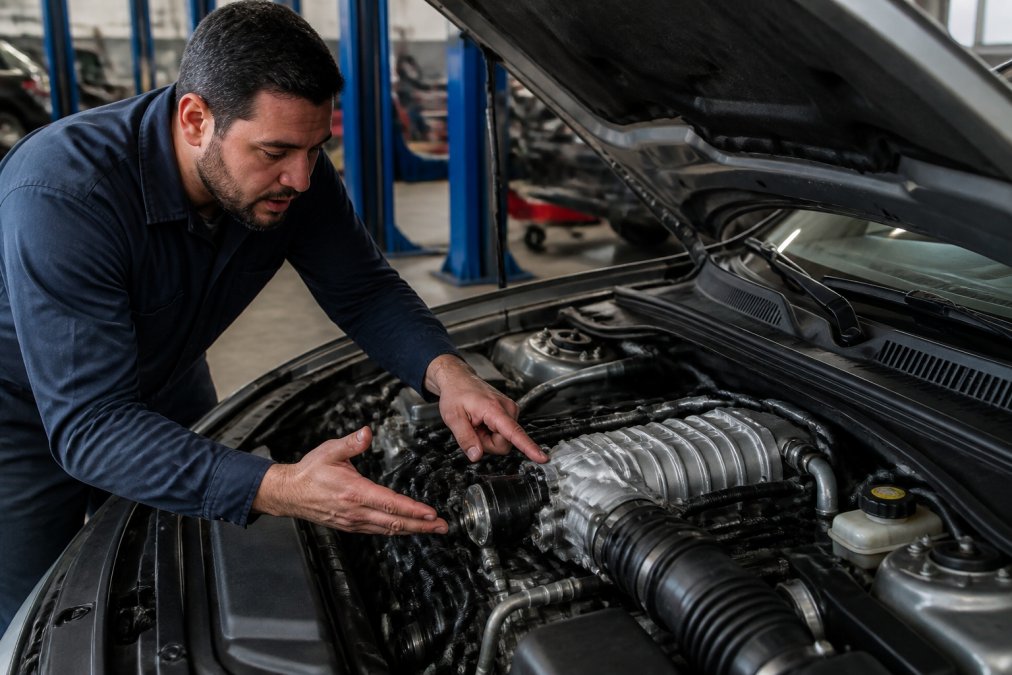
Once you have your vehicle back, do a physical inspection before you drive it. This takes 10-15 minutes and can reveal whether the work was actually completed.
Look for Signs of New Parts Installation
New parts leave physical traces. Your job is to spot them.
For brake work: Look under the wheels. New brake pads are shiny and unworn. The rotors should look freshly machined if they were resurfaced, or pristine if replaced. Old, worn rotors are dark and grooved. The brake fluid in the master cylinder (under the hood) should be clear or amber, if it’s black, the system wasn’t properly serviced (nhtsa.gov).
For battery replacement: A new battery has a recent manufacture date stamped on the top. The terminals should be clean and shiny, not corroded. The old battery should be visible in the shop (shops are required to accept old batteries for recycling).
For air filter replacement: Open your air filter box (your mechanic can show you where). A new filter is white or light-colored and clean. An old filter is dark, clogged, and dirty. If the filter looks unchanged from when you dropped it off, it wasn’t replaced.
For fluid changes: Check your oil level with the dipstick. New oil is translucent amber or brown. Old oil is dark and thick. For transmission fluid or coolant, the color should match what the shop said they used (they should have documented this on your invoice). verifying genuine parts.
For tire work: New tires have tread depth of 10/32 inch or higher. You can check with a penny, insert it into the tread with Lincoln’s head upside down. If you can see the top of his head, the tread is too shallow. Also check that all four tires match in brand and model if you authorized a full set replacement.
The physical evidence should align with your invoice. If your invoice says new parts were installed and you can’t find evidence of that work, you have a legitimate complaint.
How to Test Drive After Repair
A test drive is your second line of verification. It’s where you confirm the repair actually fixed the problem.

Start with Basic Systems
Before you focus on the specific repair, check that nothing else broke during the service.
- Lights: Turn on headlights, high beams, fog lights, turn signals, and brake lights. Have someone stand behind the vehicle to confirm all lights work.
- Wipers and washers: Test all wiper speeds and the windshield washer fluid.
- Climate control: Run the air conditioning and heater. Both should produce cold and hot air respectively.
- Power windows and locks: Test all four windows and door locks.
- Dashboard warning lights: Start the engine and check the dashboard. Ignore the brief startup sequence, but any lights that stay on after a few seconds indicate a problem.
If something that wasn’t broken before is now broken, document it and report it immediately. The shop is responsible for damage caused during the repair.
Test the Specific Repair Area
Now focus on what you came in for. The test should directly address the problem you authorized the shop to fix.
For brake repair: Find a safe, empty parking lot or quiet street. Accelerate to about 20 mph and apply the brakes firmly. They should engage smoothly without grinding, squealing, or pulling to one side. The brake pedal should feel firm, not soft or spongy. Repeat this a few times.
For engine performance issues: Drive normally through varied conditions. If the repair was for rough idle, the engine should run smooth at stops. If it was for acceleration hesitation, the car should respond smoothly when you press the gas. If it was for a check engine light, that light should be off (or the shop should have explained why it’s still on).
For suspension or steering work: Drive over some bumps at low speed. The ride should feel smooth, not bouncy. The steering should respond immediately and track straight without pulling left or right.
For transmission work: Shift through all gears (if manual) or let the transmission shift through its range (if automatic). Shifts should be smooth without grinding or hesitation.
If the problem you came in for is still present, that’s a clear sign the repair wasn’t completed properly. Return to the shop immediately with this information.
Why ASE Certified Mechanics in Boynton Provide Verification You Can Trust
ASE (Automotive Service Excellence) certification is the gold standard in the industry (ase.com). An ASE certified mechanic has passed rigorous exams and demonstrated competency in their specialty area.
When you work with ASE certified mechanics in Boynton, you’re working with professionals who’ve invested in their expertise and committed to staying current with industry standards. This certification matters because it means the work you’re paying for meets objective quality standards, not just the shop owner’s opinion.
ASE certified shops typically stand behind their work more confidently than uncertified shops. They’re more likely to offer comprehensive warranties and more willing to document their work thoroughly because they know it meets standards. This documentation becomes your verification tool.
CJ Auto Services LLC employs ASE certified mechanics who handle all makes and models, from routine maintenance to complex engine diagnostics. When you bring your vehicle to a certified shop, you’re reducing the risk that work was skipped or done improperly. Certification doesn’t guarantee perfection, but it significantly raises the baseline of quality and accountability.
Request Diagnostic Reports and Documentation
For any repair involving diagnostics, request the actual diagnostic report. This is crucial verification documentation.
A diagnostic report should show:
- Fault codes: The specific error codes the scanner found (e.g., "P0420, Catalyst System Efficiency Below Threshold")
- What was tested: Which systems the mechanic scanned and what they found
- Before and after: If applicable, the scan results before and after the repair
- Recommended repairs: What the mechanic recommended and what you authorized
This report is your paper trail showing what was wrong and what was fixed. If the shop claims they fixed a problem but has no diagnostic report showing they scanned the system, that’s a red flag.
For electronic diagnosis, ask whether the shop used computerized diagnostic equipment. Many modern vehicles require this. Manual inspection alone isn’t sufficient for most electrical or engine management issues. A shop using full computerized diagnosis (like the electronic diagnosis services at CJ Auto Services LLC) provides documented evidence of what was tested and what was found.
Keep all documentation. If a problem resurfaces after the warranty period, you’ll have proof of what was done and when. This protects you if you ever need to dispute a claim or pursue a refund.
What to Do If Repair Work Wasn’t Completed Properly
If you discover that the work wasn’t done or was done incorrectly, act quickly.
Step 1: Document everything. Take photos of any physical evidence (worn parts that should have been replaced, fluid that doesn’t match what was invoiced, etc.). Keep all paperwork, invoices, and diagnostic reports. Write down dates, times, and details of conversations.
Step 2: Return to the shop. Contact the shop immediately and explain the problem. Bring your documentation. Give the shop a reasonable opportunity to make it right, most legitimate shops will. If the repair was under warranty (which it should be), the shop should redo the work at no charge.
Step 3: Request a re-inspection. If the shop disputes your claim, ask for an independent inspection by another certified mechanic. This provides objective verification of whether the work was completed properly.
Step 4: Escalate if necessary. If the shop refuses to address the problem and you believe you were charged for work that wasn’t done, you have several options:
- File a complaint with your state’s Attorney General consumer protection division (naag.org)
- Contact the Better Business Bureau
- Dispute the charge with your credit card company (if applicable)
- Consult with a small claims court attorney if the amount is significant
These steps are rarely necessary if you work with a reputable shop from the start. But knowing your options gives you confidence to verify thoroughly without fear.
Verifying auto repair work completed isn’t about distrusting your mechanic, it’s about protecting yourself and ensuring you get what you paid for. The process is straightforward: review your invoice for itemization, inspect your vehicle for physical evidence, test drive to confirm the fix works, and request documentation.
When you need reliable auto repair in Boynton with mechanics you can trust, CJ Auto Services LLC delivers transparent service backed by ASE certified expertise and a 100% parts and labor warranty. Our team documents every repair thoroughly and welcomes customer questions. Schedule service today and experience the confidence that comes with honest, efficient automotive care.
Frequently Asked Questions
Q: How do I know if a mechanic actually fixed my car?
A: Check your invoice for itemized work details, inspect the vehicle for new parts, and test drive it to confirm the repair works as expected. Ask your mechanic to show you the old parts that were replaced, and request a detailed diagnostic report. ASE certified mechanics provide thorough documentation so you know exactly what was done. If something feels off during the test drive, return immediately and ask for clarification or a re-inspection.
Q: What should I look for on my auto repair invoice checklist?
A: Your invoice should list each service performed, parts replaced with part numbers, labor hours, warranty terms, and total cost. Verify that all work discussed before the repair is included and itemized separately. Check that new parts are clearly marked as new or used. Ensure warranty information covers both parts and labor. A transparent invoice protects you and shows the shop stands behind its work. If anything is vague or missing, ask the mechanic to clarify before you leave.
Q: Why does ASE certification matter when verifying repair quality?
A: ASE certified mechanics have passed rigorous testing in their specialty areas and must maintain continuing education. This certification means they follow industry standards and best practices, giving you confidence the work was done correctly. ASE certified mechanics in Boynton are held to national standards, making them accountable for quality. When a shop employs ASE certified technicians, you have a third-party verification that the mechanic has the knowledge and skills to complete your repair properly.
Q: What are signs of poor quality auto repair work?
A: Red flags include missing or vague invoice details, visible dirt or damage around repair areas, fluid leaks after service, unusual noises during your test drive, or parts that don't fit properly. Poor quality work often shows loose bolts, misaligned components, or incomplete reassembly. If your vehicle performs worse after repair or warning lights remain on, the work wasn't completed correctly. Trust your instincts: if something feels wrong, ask the shop to re-inspect and address the issue under warranty.
This article was written using GrandRanker


