That “free” code scan at the local auto parts store might actually be the most expensive mistake you make this year. We’ve all felt that immediate pit in the stomach when a yellow light flickers on the dashboard while driving through the sweltering Florida heat. It’s confusing and stressful; it often leads to a nagging fear that a massive repair bill is just around the corner. You’re not alone in worrying that a basic engine diagnostic service won’t give you the full story, leaving you vulnerable to being overcharged for parts your car doesn’t even need.
You deserve to know exactly what’s happening under your hood without the guesswork. This guide will show you how a professional diagnostic identifies the root cause of issues, saving you both time and money. We’ll break down the critical differences between a simple code scan and a deep-dive diagnostic, explain how 2026 regulations regarding vehicle data access benefit you, and provide a clear roadmap to get you back on the road with total peace of mind. By the end, you’ll understand why finding the “cure” is much better than just reading a symptom.
Key Takeaways
- Understand why a basic code scan is just the starting point and how a professional engine diagnostic service identifies the actual root cause to prevent replacing parts you don’t need.
- Learn the specific performance red flags, like sudden drops in fuel efficiency or engine hesitation, that signal your vehicle needs immediate expert attention.
- Discover the step-by-step process our technicians use to interrogate your car’s computer system and verify mechanical health for a reliable, first-time-right repair.
- See how specialized local expertise helps protect your engine against unique Florida environmental stressors while ensuring long-term vehicle safety and peace of mind.
What is an Engine Diagnostic Service and Why is it Critical?
An engine diagnostic service is a professional procedure where a technician uses specialized software to interface with your vehicle’s Electronic Control Unit (ECU). Think of the ECU as your car’s brain. It constantly receives data from dozens of sensors located throughout the powertrain. When something goes wrong, the ECU logs a fault code and triggers the light on your dash. A true diagnostic goes beyond just reading that code; it involves a master craftsman using that data to perform targeted physical tests, ensuring we find the exact cause of the trouble rather than just guessing with your money.
This technical conversation between our tools and your car happens through the On-Board Diagnostics (OBD) port. While basic versions existed earlier, the OBD-II system became the industry standard in 1996 for all cars sold in the United States. This standardization allows us to access a wealth of real-time information, from fuel trim levels to spark plug performance, providing a transparent window into your engine’s health without needing to take the entire motor apart first.
Living in Boynton Beach adds a unique layer of stress to these systems. Our intense Florida heat and high humidity are notorious for degrading plastic wire looms and causing electrical sensors to fail prematurely. Moisture can seep into connections, leading to “ghost” codes that might confuse a less experienced shop. We focus on the “Florida Factor” during every engine diagnostic service to ensure your sensors are actually communicating accurately in our tropical climate.
The Purpose of the Check Engine Light
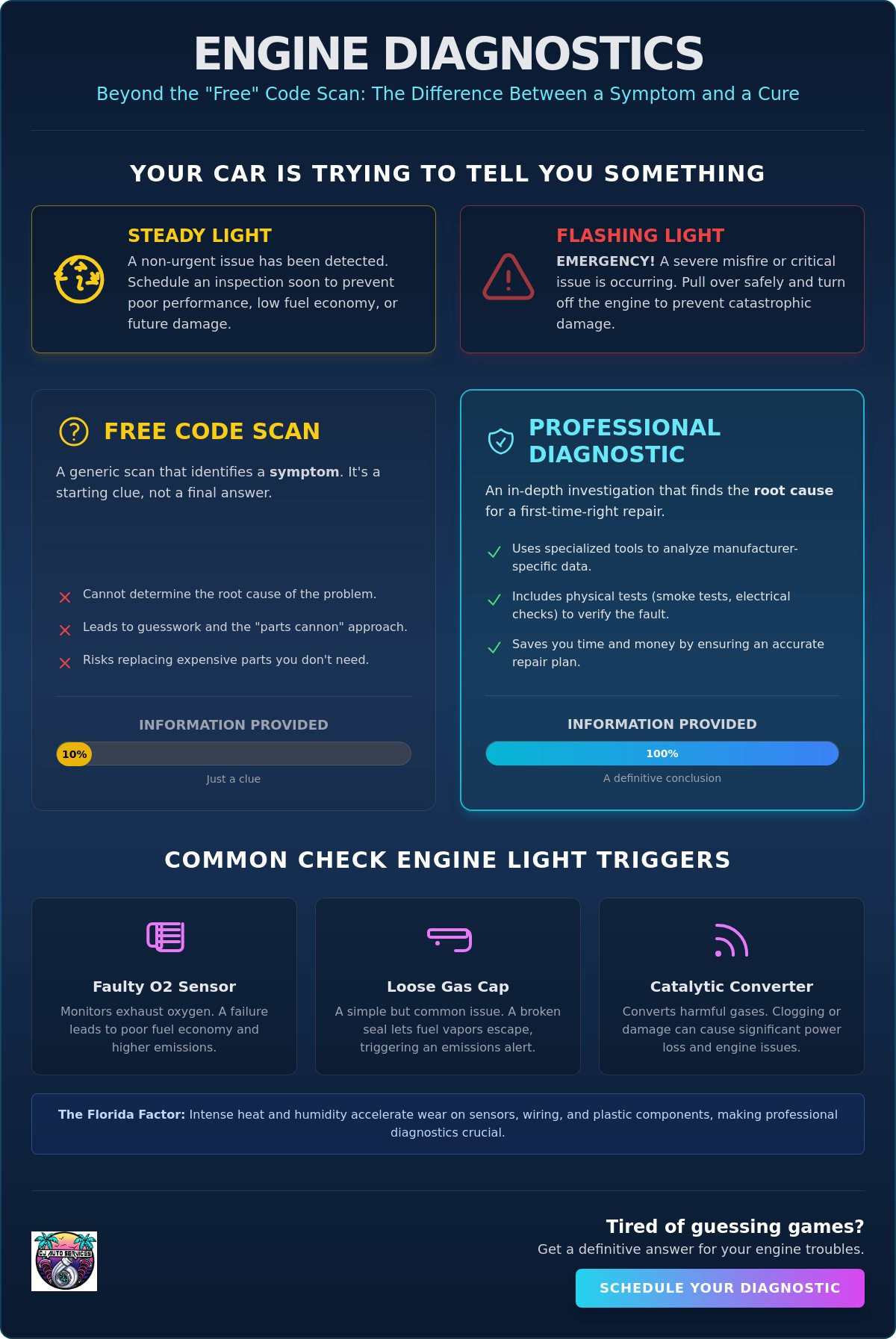
The Malfunction Indicator Lamp (MIL) is your car’s way of asking for help. Sensors throughout the engine monitor everything from oxygen levels in the exhaust to the precise fuel-to-air ratios in the combustion chamber. If the light is steady, your car has detected a problem that needs attention to prevent long-term damage or poor fuel economy. However, if that light is flashing, it’s an emergency. A flashing light usually indicates an engine misfire so severe that it could overheat your catalytic converter or lead to catastrophic engine failure. It’s a signal to pull over safely and call for help immediately.
Common Triggers for Engine Diagnostics
Several common culprits often trigger a trip to the shop. Some of the most frequent issues we see include:
- Faulty Oxygen (O2) Sensors: These monitor how much unburned oxygen is in the exhaust. If they fail, your fuel economy will plummet, and you’ll spend significantly more at the pump.
- Loose or Damaged Gas Caps: This is the simplest fix. A cap that doesn’t seal properly allows fuel vapors to escape, which triggers the evaporative emissions system alert.
- Catalytic Converter Issues: Especially in older vehicles, these can become clogged or damaged. In Florida, where we don’t have state inspections, many drivers ignore this until the car loses power or fails to start entirely.
Ignoring these warnings won’t make them go away. In fact, a minor sensor issue left unaddressed often cascades into a much larger, more expensive repair. Taking action early protects your investment and keeps your daily commute stress-free.
Code Scan vs. Full Engine Diagnostic: Understanding the Difference
A free code scan is a clue, not a conclusion. Many drivers think that once a scanner is plugged into the dashboard, the screen will simply display a message like “replace the spark plugs.” In reality, that scan only provides about 10% of the solution. It identifies a symptom, such as an irregular reading from an oxygen sensor, but it cannot tell you why that reading is off. Relying solely on a basic scan often leads to the “parts-cannon” approach, where owners replace expensive components one by one, hoping the light eventually goes out.
Our “Master Craftsman” approach treats that initial code as a starting point for a deeper investigation. While consumer-level scanners might give you a generic code, professional-grade diagnostic software allows our technicians to access proprietary manufacturer data and hidden sub-menus. We use this information to perform physical testing. For example, if a code suggests a vacuum leak, we don’t just guess which hose is bad. We use specialized smoke machines to find the exact exit point and multi-meters to check the electrical integrity of sensors. This precision saves you from paying for unnecessary repairs.
If you’re tired of conflicting dash lights and want a definitive answer, our team at CJ Auto Services LLC provides a comprehensive engine diagnostic service that gets to the truth immediately.
The Limitations of a Code Reader
Codes point to a system, not necessarily a specific part. A common “Lean Condition” code could be caused by a dirty mass airflow sensor, a vacuum leak, or even a failing fuel pump. Also, one faulty sensor can “trick” the ECU into throwing multiple false codes, creating a confusing trail of “ghost codes.” Without the expertise to interpret how these systems interact, you risk replacing a perfectly good sensor while the real problem continues to damage your engine.
What Happens During a Professional Diagnostic
During a professional diagnostic, we perform live data streaming. This allows us to observe your engine performance in real-time while it’s running, catching intermittent glitches that a static scan would miss. We combine this digital data with a thorough visual inspection of wiring harnesses and vacuum lines, which are often the true culprits behind mysterious lights. This level of detail is especially critical for European and Japanese imports, which feature intricate computer networks that require specialized knowledge to navigate safely. We look at the whole picture to ensure your vehicle is safe and reliable for the long haul.
Symptoms That Require Immediate Engine Diagnostic Service
While the check engine light is a reliable messenger, your vehicle often communicates through physical sensations before a warning lamp even flickers. Ignoring these subtle red flags can turn a simple sensor adjustment into a major mechanical overhaul. If you notice your car behaving differently during your daily commute, it is time to schedule a professional engine diagnostic service to catch the issue while it’s still manageable.
Keep a close eye and ear out for these critical symptoms:
- Noticeable Drop in Fuel Efficiency: If you find yourself at the gas pump more often than usual, your engine isn’t burning fuel efficiently. This often happens when the ECU overcompensates for a faulty sensor by “running rich,” which wastes gasoline and can eventually clog your exhaust system.
- Engine Hesitation or Surging: Feeling a stumble when you pull away from a stoplight or noticing the engine “hunting” for gears is a clear sign of trouble. This suggests a disruption in the delicate balance of air, fuel, and spark.
- Unusual Smells: A scent of rotten eggs usually points toward a failing catalytic converter, while the smell of raw gasoline could indicate a dangerous leak in the fuel lines or an injector issue. Neither should be ignored.
- Strange Sounds: Persistent tapping or knocking sounds often signal internal mechanical wear. Conversely, a sharp hissing sound usually reveals a vacuum leak or a cooling system breach that could lead to rapid overheating.
Specialized Diagnostics for European Vehicles
Precision engineering requires precision tools. Brands like BMW, Mercedes-Benz, and Audi operate on proprietary diagnostic protocols that generic scanners simply cannot read accurately. These vehicles feature highly complex systems, including variable valve timing and sophisticated turbocharging setups, that demand a deeper level of interrogation. Because these components are interconnected, a fault in one area can trigger a cascade of issues across the entire vehicle network. For owners of these fine machines, seeking out specialized European Automotive Repair in Boynton Beach ensures that your diagnostic is performed using the exact software your car’s manufacturer intended.
Diesel Engine Diagnostic Considerations
Diesel engines present a unique set of challenges that differ significantly from gasoline counterparts. Modern diesel diagnostics focus heavily on the health of the Diesel Particulate Filter (DPF) and the DEF system, which are prone to soot buildup if the engine isn’t reaching the proper operating temperatures. We also look for turbo boost leaks and fuel injector timing discrepancies that can sap your torque and power. Because diesel systems operate under extremely high pressure, our technicians use specialized testing equipment to verify fuel system integrity without risking damage to the sensitive injectors. Proper diagnostics keep your diesel engine running clean and strong for hundreds of thousands of miles.
The Step-by-Step Diagnostic Process at CJ Auto Services LLC
We believe that a truly professional engine diagnostic service is a partnership between the technician and the driver. Our process at CJ Auto Services LLC doesn’t begin with a computer; it starts with a conversation. We document your specific observations, such as when the light first appeared or if it only flickers during a cold start. This human element provides the context our tools need to work efficiently, ensuring we don’t overlook a simple intermittent glitch that only happens under certain conditions.
Once we understand the symptoms, we move into the technical interrogation phase. Our technicians retrieve every stored, pending, and permanent trouble code from your vehicle’s computer. While a pending code might not trigger a dash light yet, it often reveals a developing issue that we can catch before it leaves you stranded. We then perform live data analysis, testing your vehicle under specific load conditions to see how the engine breathes and fires in real-time. This allows us to see exactly what the sensors see while you’re actually on the road.
Before we recommend any repair, we perform component verification. If a code points to a specific sensor, we use specialized tools to test that part’s physical and electrical health. We never want to replace a part unless we can prove it has failed. Finally, we provide you with a transparent report. This isn’t just a list of parts; it’s a clear roadmap that prioritizes what your car needs to stay safe and efficient. If you’re ready for a clear answer about your vehicle’s health, you can schedule your comprehensive diagnostic with our team today.
The Importance of Electrical System Testing
Computerized diagnostics are only as good as the power supply. Modern engines are incredibly sensitive to “electrical noise,” which is why we always start by checking your battery voltage and alternator output. A weak battery or a loose ground connection can cause the ECU to throw dozens of false “ghost codes” that have nothing to do with mechanical failure. By ruling out these electrical issues first, we ensure our diagnostic data is accurate and reliable, preventing you from paying for repairs that won’t solve the problem.
Post-Diagnostic Repair Planning
After the diagnostic is complete, we help you make an informed decision. We distinguish between “Safety Critical” repairs that need immediate attention and “Monitor for Now” items that can wait. In some cases, your car might not even need a new part; it might simply require a software update or a “re-flash” of the ECU to fix a modern engine glitch. We take pride in being a Full Service Auto Repair in Boynton Beach, meaning we can handle everything from these delicate software updates to major mechanical overhauls with the same level of expert care.
Trusting Your Engine to Boynton Beach Specialists
Choosing a local partner for your vehicle’s care makes a world of difference in the longevity of your car. National chains often operate on high-volume quotas, which can lead to rushed assessments or generic advice that doesn’t fit your specific situation. As a family-owned shop, we take a different path. We understand the “Florida Factor” better than anyone because we live and work in the same environment you do. Our technicians at CJ Auto Services LLC know exactly how the relentless humidity in Boynton Beach corrodes electrical connectors and wears down rubber seals. This local insight allows us to provide a more accurate engine diagnostic service that accounts for our unique environmental stressors.
Our background in high-level performance tuning and custom work gives us a distinct edge over standard repair facilities. When you’re used to squeezing every ounce of efficiency and power out of a custom build, a standard daily driver’s engine becomes an open book. We don’t just look for what’s broken; we look for what’s about to break. This “Master Craftsman” perspective ensures that you aren’t just getting a fix for today, but a strategy for the years of driving ahead. We value the relationship over the transaction, acting as a partner who prioritizes your safety and your wallet.
Beyond the Diagnostic: Long-Term Engine Health
A diagnostic light is often the final cry for help from a neglected system. While we’re experts at finding the cure, we’d much rather help you prevent the problem from starting. There’s a direct link between consistent maintenance and a dashboard free of warning lights. For instance, staying on top of your brake repair and regular fluid flushes ensures that your vehicle’s systems aren’t working harder than they should. When one system fails, it puts extra strain on the engine, eventually triggering the sensors we’ve discussed. Routine care is the simplest way to maintain engine stability and avoid the anxiety of a sudden breakdown.
Schedule Your Diagnostic Service Today
Don’t let a small flicker on your dash turn into a major mechanical failure. Early intervention is always the most cost-effective way to manage vehicle repairs. Whether you’re dealing with a persistent light, a strange new sound, or a drop in fuel economy, our team is here to provide the clarity you need. We’ll give you a straightforward explanation of your car’s health without any confusing technical jargon. You can schedule your expert engine diagnostic at CJ Auto Services LLC today and regain the peace of mind that comes with a truly reliable ride.
Get the Answers Your Engine Deserves
Don’t let a mystery light on your dashboard steal your peace of mind. As we’ve explored, a professional engine diagnostic service is the only way to move past the ambiguity of a basic code scan and find a permanent solution for your vehicle. Whether you’re driving a precision European sedan, a reliable Japanese import, or a hard-working diesel truck, understanding the root cause of performance issues saves you from the cycle of unnecessary parts replacement and recurring stress.
At CJ Auto Services, our ASE Certified Technicians use state-of-the-art computerized diagnostic equipment to provide the transparency you deserve. We specialize in the complex systems of European, Japanese, and diesel engines, ensuring your car receives the expert care necessary for our unique Florida climate. Stop guessing and start driving with confidence again. You can Book Your Expert Engine Diagnostic in Boynton Beach today to secure your vehicle’s future. We’re ready to help you stay safe and on the road for the long haul.
Frequently Asked Questions
Is it safe to drive with the check engine light on?
It depends on how the light is behaving on your dashboard. If the light is steady, your car has detected a problem that needs attention, but you can usually drive it safely to a service center for an inspection. If the light is flashing, you must pull over and turn off the engine immediately; a blinking light signals a severe misfire that can cause permanent damage to your engine or catalytic converter.
How much does a professional engine diagnostic service cost in Boynton Beach?
The cost of a professional engine diagnostic service varies depending on the complexity of your vehicle and the specific symptoms it’s showing. While a basic code scan is often inexpensive, a comprehensive diagnostic involves expert labor and advanced software to pinpoint a root cause. We recommend calling a local specialist to discuss your car’s behavior for a transparent estimate that reflects the necessary testing time.
Will a diagnostic test tell me exactly what is wrong with my car?
A diagnostic test provides a fault code that identifies which system is malfunctioning, but it’s only the first step. The code acts as a clue that points our technicians in the right direction. From there, we perform physical tests, such as checking for vacuum leaks or testing electrical circuits, to confirm exactly which part has failed before we suggest any repairs.
How long does an engine diagnostic test take?
Most standard diagnostic procedures take between one and two hours to complete. This timeframe allows our technicians to retrieve stored data, analyze live engine performance metrics, and conduct necessary physical inspections under the hood. If your car is experiencing an intermittent “ghost” issue or a complex electrical problem, the process may take longer to ensure we find a definitive answer.
Can a loose gas cap really trigger the check engine light?
Yes, a loose or damaged gas cap is one of the most common reasons for a warning light. Your vehicle’s computer monitors the pressure in the fuel system to ensure vapors don’t escape into the atmosphere. If the cap isn’t sealed tight, the system detects a leak and triggers an evaporative emissions (EVAP) fault code, which turns on the light.
Why did my check engine light turn off on its own?
Your light likely turned off because the computer performed a self-test and found that the problem is no longer present. This often happens if you’ve recently tightened a loose gas cap or if an intermittent sensor glitch has resolved itself. Even if the light is currently off, the computer usually stores a “history code” that we can retrieve during an engine diagnostic service to understand what triggered the initial alert.
Do I need a diagnostic if my car is running fine but the light is on?
Yes, you should still have the vehicle inspected even if it feels normal to drive. A check engine light often indicates that a sensor is starting to fail or that the engine is running less efficiently than it should. Ignoring a minor light can lead to poor fuel economy and eventually cause more expensive damage to components like your catalytic converter or oxygen sensors.
Does my car need a special diagnostic if it is a European import or a diesel?