Table of Contents
- Why European Cars in Boynton Beach Need a Specialist
- European Car Diagnostic Services in Boynton Beach
- European Auto Maintenance Schedule: What to Book and When
- BMW Repair Boynton Beach: Common Failure Points by Model
- OEM vs. Aftermarket Parts: What Actually Makes Sense
- Choosing a European Mechanic Near Me: What to Look For
- Conclusion
- Frequently Asked Questions
Last Updated: September 15, 2026
Why European Cars in Boynton Beach Need a Specialist
If you drive a BMW, Audi, Porsche, or Volkswagen in Boynton Beach, Florida, you already know these cars don’t behave like domestic or Asian vehicles under the hood. According to BMW of North America’s official service information, modern European vehicles rely on proprietary software, tight tolerances, and model-specific parts that generic shops often can’t read or replace correctly. At CJ Auto Services LLC, we’ve built our entire shop around that reality: father-and-son owned, ASE Certified, and focused on the German and European makes that demand more from a mechanic.
That’s the core issue with searching for a European mechanic near me in Boynton Beach: the label “mechanic” hides a huge range of skill levels. A shop that’s great with a Ford F-150 may have zero experience with a Porsche’s PDK or an Audi’s quattro drivetrain. Choosing wrong can turn a small issue into a recurring one.
Below, we’ll show you exactly what to book, when to book it, and how to tell a true European specialist from a generalist.
European Car Diagnostic Services in Boynton Beach
European car diagnostic services use manufacturer-specific software to read fault codes and live sensor data and pinpoint what’s actually wrong. Dealer-level scan tools read hundreds of modules a basic code reader can’t access.
A generic OBD-II reader might tell you “misfire on cylinder 3.” A proper diagnostic platform tells you why: a failing ignition coil, a vacuum leak, or a fuel injection issue specific to your engine code.
Dealer-Level Diagnostics Without the Dealer Wait
The biggest complaint we hear from Boynton Beach drivers is the dealer wait: days for an appointment slot and a vague phone call about “recommended services.” We do it differently: same-day appointments, a clear explanation of what we found, and a repair plan you approve before we touch anything.
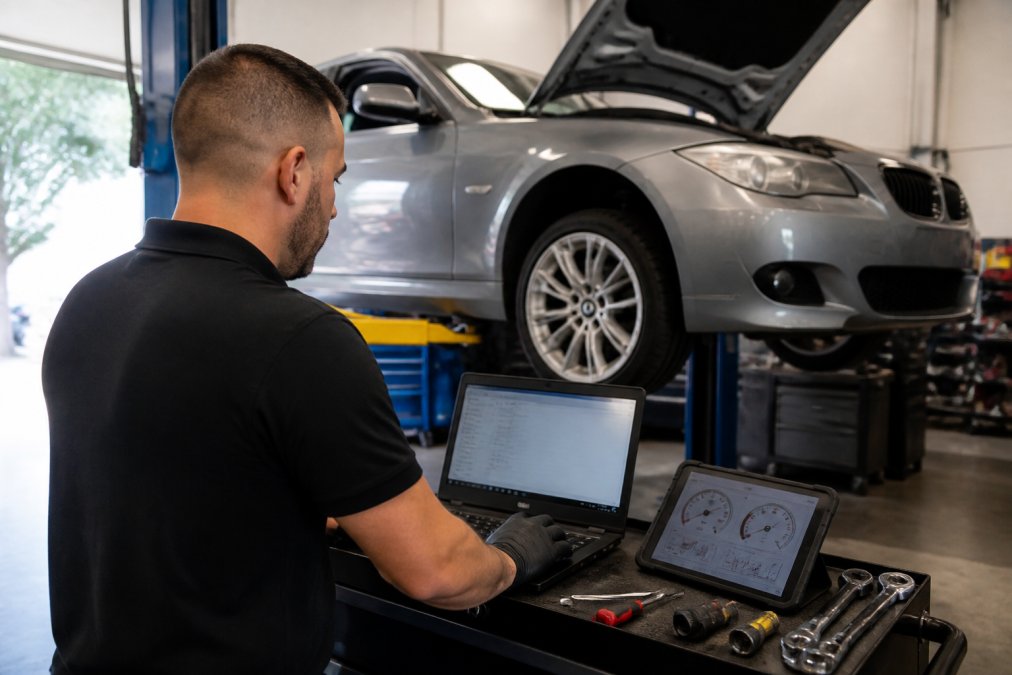
Our computerized diagnostics cover the check engine light, electrical diagnostics, and drivetrain faults. If you’ve been putting off a warning light, that’s the appointment to book first, transparent pricing means you know the cost before the work starts.
European Auto Maintenance Schedule: What to Book and When
A European auto maintenance schedule is the manufacturer-recommended timeline for oil changes, inspections, and wear-item replacement, following it keeps a BMW, Audi, Porsche, or Volkswagen running past 150,000 miles. Skipping it is the fastest way to turn a reliable car into an expensive one.
European intervals differ because of engineering. Turbocharged direct-injection engines, long-life coolant formulations, and condition-based service sensors (BMW’s CBS, Audi’s service interval display) mean the car itself decides when some services are due. A generic “every 3,000 miles” rule from an older domestic vehicle doesn’t apply, and a shop that treats your BMW like a Honda will either over-service it or miss what matters.
Here’s a practical breakdown of what most European vehicles need, based on factory-scheduled maintenance intervals:
|
Service |
Typical Interval |
Why It Matters |
|---|---|---|
|
Full synthetic oil change |
7,500-10,000 miles (or per CBS/service display) |
Protects turbo bearings and timing chain components |
|
Brake fluid flush |
Every 2 years |
Fluid absorbs moisture; boiling point drops in Florida heat (aaa.com) |
|
Brake pad/rotor inspection |
Every 12 months |
Stop-and-go coastal traffic accelerates pad wear |
|
Coolant system check |
Every 30,000 miles |
Prevents overheating in summer traffic |
|
Timing belt replacement |
60,000-100,000 miles (engine-dependent) |
Failure can destroy the engine |
|
Spark plugs |
40,000-60,000 miles on turbo engines |
Worn plugs cause misfires and rough idle |
|
Cabin and engine air filters |
Every 15,000-30,000 miles |
Florida pollen and humidity clog filters fast |
|
Suspension inspection |
Every 12 months |
Potholes and heat wear bushings and control arms |
|
Battery test |
Annually after year 3 |
Heat shortens battery life significantly |
|
Every 40,000-60,000 miles |
Removes intake valve carbon buildup |
Model-Specific Intervals Worth Knowing
Generic tables only get you so far. A few patterns we see regularly on Boynton Beach European vehicles:
- BMW N20/N26 and N55 engines: Oil change intervals should be tightened toward the 7,500-mile end of the range, not the 10,000-mile end, because turbo heat and Florida ambient temperatures accelerate oil breakdown.
- BMW N54/N55 direct-injection engines: Intake valve carbon buildup is a known issue.
- Audi 2.0T (EA888) engines: Timing chain tensioner wear is a documented concern on earlier generations; inspection at 60,000-80,000 miles is prudent.
- Porsche models: Brake fluid and coolant services are often more frequent than owners expect, and the flat-six layout in 911s makes some jobs more labor-intensive than the interval alone suggests.
- Volkswagen TDI and 2.0T: DSG fluid service intervals are strict, missing them is one of the most common causes of premature wear.
Florida Heat and Your Service Intervals
South Florida’s heat degrades coolant, shortens battery life, and stresses air conditioning far more than a cooler climate. Many European owners find their AC and cooling systems need attention sooner than the owner’s manual suggests. If your AC blows warm or your temperature gauge creeps up in traffic, don’t wait for the next interval.
Coastal humidity adds a second factor: brake rotors on cars parked near the ocean surface-rust faster, and rubber suspension bushings dry out and crack sooner than inland. Keep a 12-month suspension and brake inspection on the calendar even if you’re a low-mileage driver. Corroded electrical components can also lead to unexpected security system malfunctions, making it essential to maintain reliable contacts for automotive lockout assistance should your vehicle fail to recognize your key fob.
DIY vs. Professional: What You Can Safely Handle
Cabin air filters, engine air filters, wiper blades, and checking fluid levels are reasonable DIY tasks on most European models. What’s not reasonable without dealer-level tools: resetting service indicators, diagnosing check engine lights, brake fluid flushes (which require a pressure bleeder and ABS cycling), and anything involving the timing chain or turbo system. If you’re unsure, ask, a good specialist will tell you honestly whether a job is worth doing yourself.
BMW Repair Boynton Beach: Common Failure Points by Model
BMW repair in Boynton Beach follows predictable patterns once you know the models and engine codes. Certain generations develop certain issues at certain mileages, and catching them early is the difference between a minor fix and a major one, model-specific knowledge a generalist shop simply doesn’t carry.
Here’s what we see most often, organized by chassis and engine:
BMW 3-Series (E90 / F30)
- N20 and N26 engines (F30 328i): Timing chain guide failure is a documented concern, often showing up between 60,000 and 100,000 miles (nhtsa.gov). Symptoms include a whining noise on cold start and, in advanced cases, a check engine light for camshaft correlation. Catching it early prevents catastrophic engine damage.
- N55 engines (F30 335i): Valve cover gasket leaks are common as mileage climbs, you’ll often smell burning oil after parking. The oil filter housing gasket is a related failure point on the same engine.
- E90 (2006-2013): Water pump and thermostat failures are so common they’re almost a scheduled item. The electric water pump on N52 engines typically fails without warning, which is why many specialists recommend replacing it proactively past 70,000 miles.
BMW 5-Series (F10)
- N55 and N63 engines: Cooling system components, expansion tanks, hoses, and the water pump, tend to need attention first.
BMW X3 and X5
Older Models (E46, E39)
Why Model Knowledge Matters
OEM vs. Aftermarket Parts: What Actually Makes Sense
Here’s a quick decision framework:
Choosing a European Mechanic Near Me: What to Look For
Use this when you’re evaluating any shop:
Conclusion
Frequently Asked Questions
Why do European cars require specialized mechanics?
European vehicles from BMW, Audi, Porsche, Mercedes-Benz, and Volkswagen use proprietary electronic systems, tighter tolerances, and factory-specific service procedures. A general shop without dealer-level diagnostic equipment often guesses at problems or replaces parts that were not the cause. An experienced European mechanic uses computerized diagnostics, OEM parts, and factory-scheduled maintenance intervals to keep engine performance, brakes, and electrical systems working the way the manufacturer intended.
How often should I service my European vehicle in Boynton Beach?
Most European manufacturers recommend oil changes and a vehicle inspection every 10,000 miles or once a year, whichever comes first. Florida heat, stop-and-go traffic, and humidity shorten some intervals, so many drivers in Boynton Beach benefit from a preventative maintenance check every 6,000 to 7,500 miles. Brake system service, coolant system checks, and air conditioning service should be inspected annually regardless of mileage.
What should I look for in a local European auto repair shop?
Look for ASE certified technicians, dealer-level diagnostic tools, a clear parts and labor warranty, and honest recommendations before work begins. Ask whether the shop handles BMW, Audi, Porsche, and Volkswagen regularly, and whether they use OEM or quality aftermarket parts. A family-owned shop like CJ Auto Services LLC in Boynton Beach offers same-day appointments, free pick-up and drop-off, and a 100% parts and labor warranty.
Are ASE Certified mechanics better for European car repairs?
ASE certification confirms a technician has passed standardized testing on specific repair systems, including engine performance, brakes, and electrical diagnostics. It does not replace brand-specific training, but it does signal a baseline of verified skill. For European car diagnostic services and precision repair, combine ASE certification with hands-on experience on BMW, Audi, and Volkswagen platforms to get the best results.


