Table of Contents
- What Complete Automotive Service Actually Covers
- ASE Certified Mechanics in Florida vs General Mechanics
- Independent Auto Shop vs Dealership: Key Differences
- Vehicle Maintenance Warranty Coverage Explained
- How to Verify Quality and Transparency in Auto Repair
- Complete Automotive Service: Cost vs Value
- Choosing Your Service Provider: Decision Framework
What Complete Automotive Service Actually Covers
A complete automotive service goes far beyond an oil change. It’s a comprehensive inspection and maintenance program that addresses your vehicle’s critical systems to prevent breakdowns, extend longevity, and keep you safe on the road. At CJ Auto Services LLC, we define complete automotive service as preventative maintenance combined with diagnostic testing and targeted repairs based on factory scheduled maintenance intervals.
Complete automotive service typically includes routine maintenance services like oil changes, fluid exchanges, brake inspections, and tire rotation. But it also encompasses diagnostic testing to catch emerging problems before they become expensive failures.
The difference between a basic service and a complete one matters more than most vehicle owners realize. A basic service might cost less upfront, but skipping diagnostic procedures means you’re driving blind. Hidden transmission issues, battery problems, or sensor failures won’t announce themselves until they strand you on the highway.
Ask your mechanic for a complete vehicle health report before leaving the shop. A thorough diagnostic testing report shows exactly what’s working, what needs attention soon, and what can wait. This transparency is what separates shops that truly care about your vehicle from those just chasing the next service ticket.
ASE Certified Mechanics in Florida vs General Mechanics
The credential matters more than you’d think. An ASE Certified Mechanic has passed rigorous national exams covering engine repair and performance, transmission systems, brake systems, electrical systems, and more. General mechanics may have experience, but ASE certification proves they’ve met a standardized threshold of knowledge and stay current with industry requirements.
Here’s the practical difference: ASE-certified technicians understand modern automotive diagnostics. Your vehicle’s computer system runs thousands of checks per second. A certified mechanic knows how to read that data and translate it into actionable repairs. A general mechanic might guess based on symptoms.
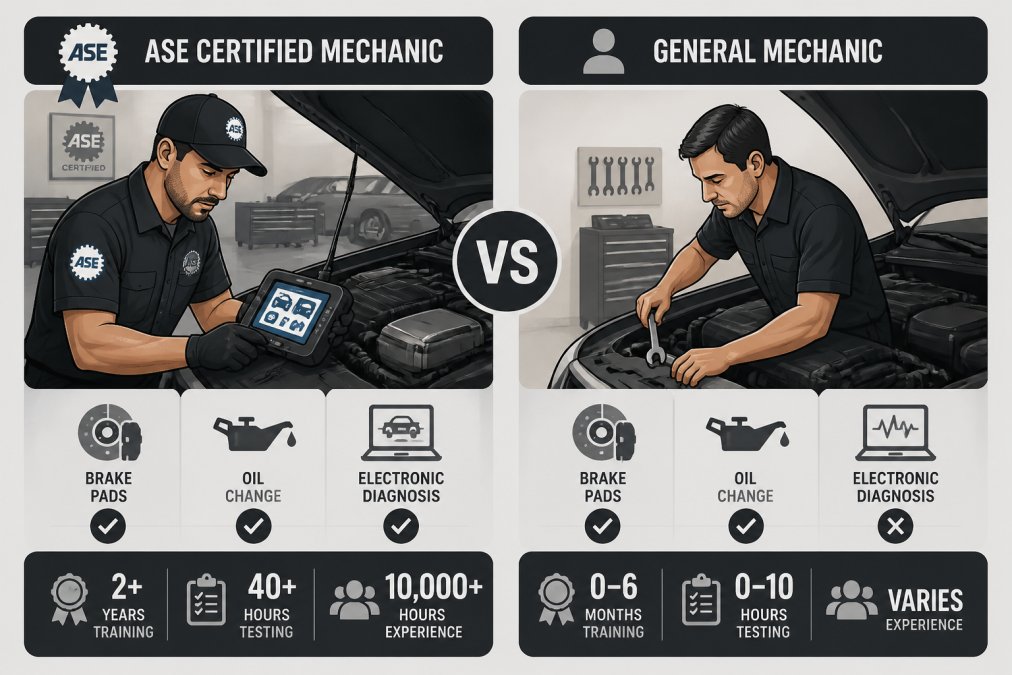
CJ Auto Services LLC employs ASE Certified Mechanics who stay current with evolving vehicle technology. This matters especially if you drive a high-performance or diesel vehicle. Diesel engines operate under different pressures and require specialized knowledge. A shop that services all makes and models with certified technicians reduces the risk you’ll be sent elsewhere when your specific vehicle arrives.
The certification doesn’t guarantee perfection, but it does guarantee training. ASE requires continuing education, mechanics must recertify every five years. That means your certified technician isn’t relying on knowledge from 2015. They’re staying current with the newest engine designs, emission systems, and diagnostic procedures.
A shop claiming to service all makes and models but lacking ASE certification is a red flag. Modern vehicles are complex. If the shop isn’t investing in certified expertise, they’re cutting corners elsewhere too, likely on parts quality or warranty coverage.
Independent Auto Shop vs Dealership: Key Differences
The choice between an independent garage and a dealership hinges on three factors: cost, convenience, and warranty implications. Both can deliver quality work, but they operate under different constraints.
Dealerships stock OEM (Original Equipment Manufacturer) parts and employ technicians trained specifically on their brand. This matters for vehicles still under factory warranty. Using OEM parts and authorized service protects your warranty coverage. If something fails and the dealership can prove you went to an independent shop using aftermarket parts, they may deny the claim.
Independent auto shops typically offer faster turnaround and lower labor rates. They’re more likely to offer same-day service and convenient options like free vehicle pick-up and drop-off. CJ Auto Services LLC, for example, handles all makes and models with same-day appointments and complimentary pick-up and drop-off.
Here’s where it gets interesting: the warranty question. Many vehicle owners assume that using an independent shop voids their factory warranty. That’s partially true. Using an independent shop doesn’t void your entire warranty, but it does create risk. If a repair performed at an independent shop later causes a failure, the dealership may deny coverage for that failure. The safest approach if you’re under factory warranty is to use the dealership for major work, then use independents for routine maintenance and non-warranty repairs.
For vehicles out of warranty, independent shops offer better value. You’re not paying for the dealership’s overhead, and you get more personalized service. A shop like CJ Auto Services LLC builds relationships with customers and knows their vehicles’ history.
| Aspect | Independent Shop | Dealership |
|---|---|---|
| Labor Cost | Lower | Higher |
| Appointment Speed | Same-day common | Often 1-2 weeks |
| Convenience Services | Pickup/dropoff available | Rarely offered |
| Parts Quality | OEM or quality aftermarket | OEM only |
| Warranty Risk | Lower for out-of-warranty vehicles | Protects factory warranty |
| Expertise | Broad across makes/models | Brand-specific |
Vehicle Maintenance Warranty Coverage Explained
Understanding what your warranty actually covers prevents costly surprises. There are three types: factory warranty, extended warranty, and shop warranty.
Factory warranty comes with your vehicle and typically covers defects in materials and workmanship for 3 years or 36,000 miles. It does NOT cover wear items like brake pads, oil, or tires. It also does NOT cover damage from accidents, neglect, or using an unauthorized repair facility. This is why the dealership vs. independent shop question matters, factory warranty coverage can be denied if you use an unauthorized shop for repairs that later cause a failure.
Extended warranty is an optional purchase that extends coverage beyond the factory period. These vary widely. Some cover everything; others exclude wear items and certain systems. Read the fine print. A common mistake is buying extended warranty without understanding what’s excluded.
Shop warranty is what you get from your repair facility. CJ Auto Services LLC offers a 100% parts and labor warranty, which means if something we repair fails, we fix it at no cost. This is significant. It means the shop stands behind its work. A shop offering a strong warranty is confident in its technician quality and parts sourcing.
The warranty conversation should happen before work starts. Ask your mechanic: "What’s covered by your warranty? How long does it last? What’s excluded?" A transparent shop will answer clearly. A shop that deflects or gives vague answers is hiding something.
A 100% parts and labor warranty from your repair shop is your safety net. It means the shop assumes the risk if something fails, not you. This is why choosing a shop that backs its work matters as much as the price.
How to Verify Quality and Transparency in Auto Repair
Transparency is where most shops fail. They perform work, hand you an invoice, and you never see what they actually did. A quality shop shows you the work.
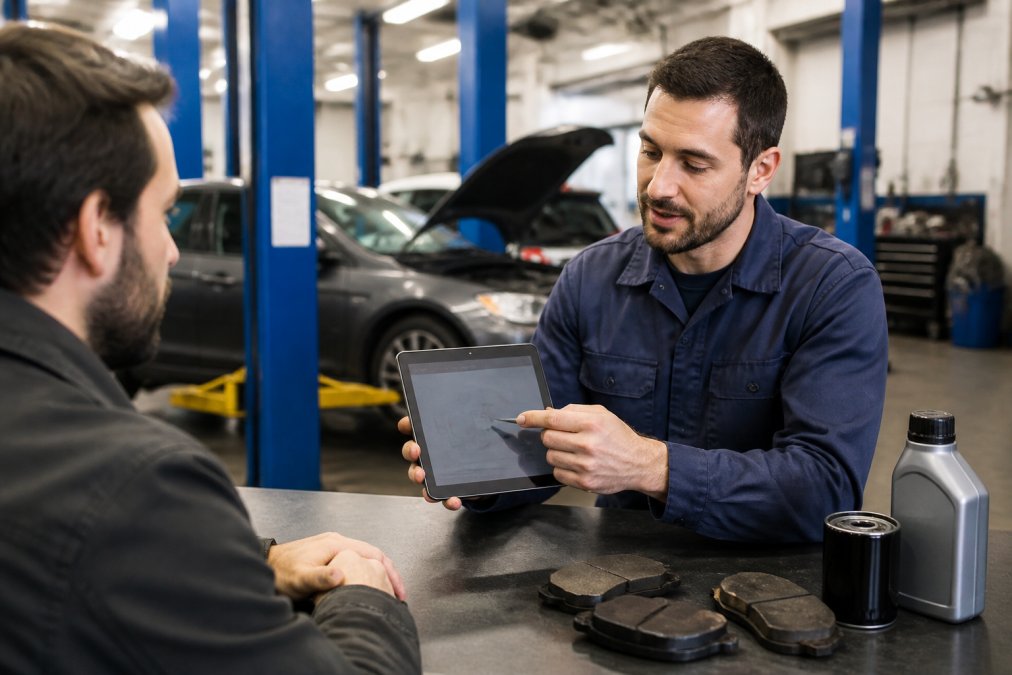
Start by asking for a detailed estimate before any work begins. This estimate should list every service, the parts required, labor time, and total cost. If the shop refuses to provide an estimate or gives you a vague number, walk out. A professional shop has nothing to hide.
Request digital diagnostic reports. Modern vehicles generate diagnostic data. A quality mechanic will show you the actual diagnostic codes, what they mean, and why the repair is necessary. CJ Auto Services LLC, for example, offers electronic diagnosis for $100.00, which includes a full computerized diagnostic report. This transparency proves the work is data-driven, not guesswork.
Ask about parts sourcing. Will they use OEM parts, quality aftermarket parts, or whatever’s cheapest? A shop that’s transparent about parts quality is one you can trust. Aftermarket parts aren’t inherently bad, many are excellent, but you deserve to know what you’re getting.
Check for communication throughout the repair. A quality shop calls if they discover additional problems. They don’t just add charges to your bill without approval. They explain what they found, why it matters, and give you options.
Look at customer reviews, but read them critically. Generic five-star reviews without detail are less meaningful than specific feedback. The real signal is whether customers mention transparency, communication, and whether they felt treated fairly. CJ Auto Services LLC’s customer reviews consistently mention honesty and clear communication, that’s the standard you should expect.
Before leaving the shop, ask to see photos of the work performed. Many shops now document repairs with photos. Seeing your old brake pads next to the new ones, or the worn-out battery they replaced, proves the work was actually done. If a shop refuses to show you, that’s a warning sign.
Complete Automotive Service: Cost vs Value
Price and value are not the same thing. A $50 oil change is cheap. An $85 oil change with full synthetic fluid, system inspection, and a diagnostic report is value.
Complete automotive service costs more than basic maintenance because it includes labor for thorough inspection and diagnostic testing. CJ Auto Services LLC’s oil change service runs $85.00 for full synthetic up to 5 quarts, which includes a complete vehicle health check. Compare that to a quick-lube shop charging $30 for conventional oil and no inspection.
Here’s what most people miss: the cheap service often costs you more in the long run. Skipping diagnostic testing means you don’t catch the transmission fluid leak until your transmission fails. That repair runs $2,000 to $5,000. The $50 you saved on inspection just cost you thousands.
Value comes from prevention. Factory scheduled maintenance intervals exist because engineers know when components wear out. Following these intervals with preventative care keeps your vehicle reliable. A complete automotive service ensures you’re actually following those intervals, not just guessing.
Consider also the convenience factor. Free vehicle pick-up and drop-off might seem like a luxury, but it’s valuable for busy professionals. You don’t lose a day sitting in a waiting room. That time has value.
The warranty backing the work also factors into cost vs. value. A shop offering 100% parts and labor warranty is assuming risk you’d otherwise carry. If a repair fails under warranty, you’re not paying again. That warranty has real financial value.
Compare shops on total cost of ownership over time, not just the price of today’s service. A slightly more expensive shop with transparent pricing, comprehensive diagnostics, strong warranty, and convenient service might cost less over five years than a cheap shop that misses problems and delivers surprises.
Choosing Your Service Provider: Decision Framework
The decision comes down to five factors: certification, transparency, warranty, convenience, and fit.
Certification means ASE-certified mechanics on staff. This is non-negotiable for complex repairs or vehicles with specific requirements like diesel engines. For basic maintenance, it matters less, but it’s still a signal of professionalism.
Transparency is the biggest differentiator. Before choosing a shop, ask three questions: Will you provide a detailed estimate before work starts? Will you show me diagnostic reports? Will you call if you find additional problems? If the answer to any is no, keep looking.
Warranty protects you after you leave. A 100% parts and labor warranty means the shop stands behind its work. This is especially valuable for major repairs like brake work or transmission service.
Convenience matters more than people admit. If a shop offers same-day service and free pick-up and drop-off, that’s worth paying slightly more. Your time has value.
Fit is subjective but important. Do you feel heard when you describe your vehicle’s symptoms? Does the mechanic explain things in language you understand? Do you trust them? A shop where you feel respected and understood is worth more than a shop that treats you like a transaction.
For vehicle owners in the local area, CJ Auto Services LLC checks all five boxes: ASE certified mechanics, transparent diagnostic procedures, 100% warranty coverage, same-day appointments with free pick-up and drop-off, and a customer-focused approach. The shop has built trust over years of honest service, evident in customer feedback mentioning reliability and fair pricing.
Frequently Asked Questions
What does a complete automotive service center actually cover?
A complete automotive service center handles routine maintenance (oil changes, tire rotation, fluid exchanges), diagnostic testing for engine and transmission issues, brake inspections, battery testing, and safety inspections. Quality shops like CJ Auto Services provide electronic diagnosis ($100.00) to identify problems accurately. The scope depends on your vehicle's service interval and condition, but comprehensive centers service all makes and models with factory scheduled maintenance expertise.
Are ASE certified mechanics better than general mechanics?
ASE (Automotive Service Excellence) certified mechanics have passed rigorous national exams and maintain current industry knowledge. They're required to have hands-on experience and stay updated on new vehicle technology. General mechanics may lack formal certification. For specialized work like diesel engines or high-performance vehicles, ASE certification signals expertise and accountability. It's a measurable quality standard that protects you.
What should I look for in vehicle maintenance warranty coverage?
Check whether the warranty covers parts and labor (not just parts), how long it lasts, and what's excluded. A 100% parts and labor warranty means the shop stands behind its work completely. Ask about coverage limits on specific components like transmission or engine work. Verify the warranty is honored if you service elsewhere later. Independent shops often offer stronger warranties than chains because they're accountable directly to you.
Is it better to go to a dealership or an independent complete automotive service center?
Dealerships use OEM (original equipment manufacturer) parts and know your specific vehicle model well, but typically charge higher labor rates. Independent shops often provide personalized service, competitive pricing, and faster turnaround. Many offer free pick-up and drop-off, same-day appointments, and transparent estimates. Choose based on warranty strength, technician expertise (ASE certification), and whether you value convenience over brand loyalty.
Choosing the right auto repair provider means looking beyond price. A complete automotive service from a shop that prioritizes transparency, employs certified technicians, and backs its work with a comprehensive warranty protects your transportation investment and your safety. Schedule service with CJ Auto Services LLC and experience the difference that professional expertise, honest communication, and genuine customer care make in keeping your vehicle reliable for years to come.
This article was written using GrandRanker


