Did you know there are over 352,800 light-duty diesel vehicles on Florida roads today, yet many owners still struggle to find a shop that truly understands the unique needs of a high-compression engine? It’s common to feel a bit of anxiety when you see dark soot buildup or wonder if a local technician actually understands the strict European specs your car requires. You want your engine to last for the long haul, but the intense Boynton Beach heat and humidity in 2026 put a massive strain on your lubrication system.
In this guide, you’ll discover how a professional diesel engine oil change service goes beyond a simple fluid swap to manage soot and maximize your fuel efficiency. We’ll also explore the new API PC-12 oil standards and how they provide better wear protection for your modern aftertreatment systems. We will break down the chemistry of specialized diesel care and help you ensure your vehicle meets the exact manufacturer requirements for peak performance. You’ll walk away with the confidence that your engine is protected by the right spec oil, ensuring a longer life for your vehicle and total peace of mind on the road.
Key Takeaways
- Understand why diesel oil chemistry is vital for neutralizing sulfuric acid and managing high combustion pressures.
- Discover why a comprehensive diesel engine oil change service must prioritize the oil filter and fuel-water separator to maintain peak performance.
- Recognize the subtle warning signs of oil degradation, such as sluggish turbo response or unusual engine knocking during idle.
- Learn how the South Florida climate accelerates oil oxidation and how to protect your engine from humidity-related moisture buildup.
- Gain peace of mind by seeing how expert diagnostics and European-spec care keep your Audi, BMW, or Mercedes running efficiently.
Why Your Diesel Engine Oil Change Service is Different from Gas Engines
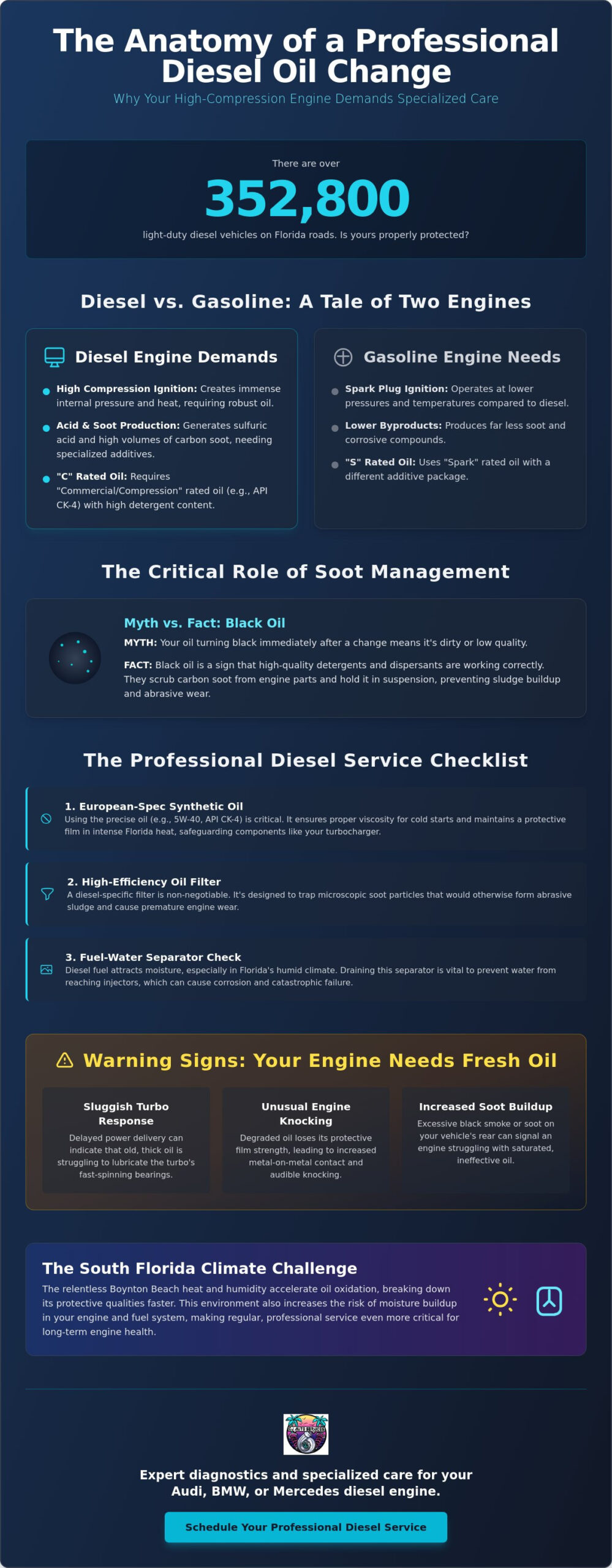
Diesel engines aren’t just larger versions of gasoline engines; they’re entirely different machines with unique chemical needs. While a gas engine relies on spark plugs, a diesel engine uses extreme compression to ignite fuel. This process creates immense internal pressure and significantly higher operating temperatures. Because of this harsh environment, your diesel engine oil change service requires specialized lubricants designed to neutralize sulfuric acid and other corrosive byproducts that gasoline engines simply don’t produce in the same quantities.
When choosing oil, you’ll notice specific API ratings on the bottle. Gasoline oils carry an “S” (Spark) rating, while diesel engines require a “C” (Commercial or Compression) rating. These “C” rated oils contain a much higher concentration of additives. These chemicals are essential for protecting the heavy-duty components of your engine from the high-stress loads they face every day. Using the wrong oil isn’t just a minor mistake; it can lead to rapid engine degradation because it lacks the chemical strength to fight off acid buildup.
A common concern for new diesel owners is seeing their oil turn jet black almost immediately after a service. It’s important to understand that this is actually a sign of high-quality oil doing its job. Unlike gas engines, diesels produce a significant amount of carbon soot. The detergents in a professional-grade Motor oil for diesel engines are designed to scrub this soot away and hold it in the fluid, preventing it from settling on vital engine parts. If the oil stays clear, it means the soot is likely sticking to your engine internals instead.
Understanding Viscosity and Flow Rates
Viscosity is the measure of a fluid’s resistance to flow at a specific temperature. In the context of diesel protection, the right viscosity ensures that oil can reach critical components like turbochargers the moment you turn the key. Most modern diesels in Florida thrive on weights like 5W-40 or 15W-40. These specific weights provide a thin enough consistency for safe cold starts while maintaining a thick, protective film during a long haul in the Boynton Beach heat. Proper flow is especially vital for your turbocharger, which can spin at over 100,000 RPM and requires a constant, cooling cushion of oil to prevent bearing failure.
The Critical Role of Soot Management
Soot is essentially fine carbon dust that enters the oil during the combustion process. High-quality diesel oil uses dispersants to keep these tiny particles separated and “in suspension.” If you leave oil in your engine past its service interval, the oil becomes saturated, and the soot begins to clump together. This creates an abrasive sludge that acts like sandpaper on your engine’s bearings and seals. Because a standard gas engine oil isn’t formulated to handle this volume of carbon, it would lose its lubricating properties and fail a diesel engine within hours of operation.
The Essential Components of a Professional Diesel Oil Service
A professional diesel engine oil change service is about more than just draining a pan and swapping a filter. It’s a technical inspection of the systems that keep your vehicle moving. Modern engines require specific lubricants like API Service Category CK-4 to handle the intense heat and soot production common in high-pressure combustion. High-quality synthetic oil is the gold standard for these machines. It provides the shear stability needed to protect expensive turbochargers and high-pressure fuel systems, even under the heavy loads often found in South Florida.
Don’t overlook the oil filter; it’s arguably the most critical component of the entire process. While gasoline engine filters catch relatively large debris, diesel filters must trap microscopic soot particles before they can cause internal wear. Additionally, checking the fuel-water separator is a non-negotiable step in a proper service. Diesel fuel naturally attracts moisture. If that water reaches your injectors, it can cause corrosion and catastrophic damage. Draining this separator ensures your fuel system remains pristine and protected.
We also pay close attention to the Diesel Particulate Filter (DPF). This component captures exhaust soot to meet strict emissions standards. If your oil is low quality or you skip services, the DPF can clog quickly, leading to “limp mode” and expensive repairs. A professional service includes a visual and diagnostic inspection of these systems to catch small issues before they become major headaches. If you want a partner who treats your truck like their own, you can always schedule your next visit with us for a thorough inspection.
Diesel-Specific Filtration Systems
Diesel engines move a massive volume of oil to keep internal parts cool and lubricated. High-efficiency particulate filters are designed with thicker media and stronger internal housings than standard automotive filters. Using a cheap, generic filter can lead to catastrophic oil pressure drops because the media might collapse under the pressure of cold, thick diesel oil. We also recommend changing secondary fuel filters during your diesel engine oil change service to maintain optimal flow and protect the high-pressure fuel pump from premature failure.
Comprehensive Fluid and System Health Checks
Maintaining a diesel vehicle involves monitoring several interconnected systems. We check your Diesel Exhaust Fluid (DEF) levels and quality, as contaminated DEF can trigger engine derate or shutdown. Our team also inspects turbocharger coolant lines and oil return pipes for any signs of seepage or heat-related fatigue. This complete auto repair approach ensures your vehicle leaves the shop in peak condition, ready to handle the toughest Florida roads.
Warning Signs: When Your Diesel Engine Demands Fresh Oil
Your diesel engine usually tells you when it’s struggling. While these powerplants are naturally louder than gasoline versions, a sudden increase in “knocking” or a sharp metallic tapping during idle is a clear signal. This often happens because the oil has thinned out or lost its ability to cushion the heavy moving parts. If you notice these sounds, a professional diesel engine oil change service is the first step to preventing expensive metal-on-metal wear. It’s about catching the problem before a small tick turns into a total engine failure.
Watch your fuel gauge and your dashboard indicators closely. A sudden drop in miles per gallon or a sluggish response when you hit the accelerator usually means your turbocharger isn’t getting the lubrication it needs to spool up efficiently. Modern diesels also feature sophisticated sensors that monitor oil life based on your driving habits. If your “Change Oil” light or a DPF warning indicator appears, your vehicle’s computer has likely detected that the oil can no longer manage the soot levels we discussed earlier. Ignoring these lights can lead to a forced “limp mode” that restricts your speed to protect the engine.
Check your dipstick at least once a month. Fresh oil should be fluid, but if it looks like thick molasses or has a milky, frothy texture, you have a serious problem. Milky oil suggests coolant is leaking into the lubrication system, while overly thick oil means it’s heavily oxidized or completely saturated with soot. You can find more general tips in our guide on 5 signs your car needs an oil change. Staying proactive with these checks keeps your maintenance costs predictable and your vehicle reliable.
Visual and Auditory Red Flags
Listen for a change in the rhythmic “diesel clatter.” If it sounds sharper or more erratic, your oil’s film strength is likely failing. Look at your exhaust too. Blue smoke often points to oil burning, while excessive black smoke can indicate that dirty oil is affecting fuel atomization. Don’t ignore your nose. If the oil smells like raw diesel fuel, you’re dealing with fuel dilution, which rapidly destroys the oil’s ability to protect your bearings. This requires an immediate diesel engine oil change service to flush out the contaminants.
Performance Degradation Indicators
Degraded oil causes your Diesel Particulate Filter (DPF) to work much harder. When oil can’t trap soot effectively, more particles reach the filter, triggering frequent and fuel-consuming regeneration cycles. This also impacts Variable Geometry Turbochargers (VGT). The tiny vanes inside these turbos rely on clean oil to move freely. When soot-heavy oil coats these parts, you’ll experience “turbo lag” and a significant loss of pulling power. Keeping your oil fresh ensures these complex components stay clean and responsive.
Maintaining Diesel Performance in the South Florida Climate
Living in Boynton Beach means your vehicle faces environmental challenges that most national maintenance schedules don’t account for. The intense Florida sun doesn’t just affect your paint; it significantly impacts what’s happening inside your crankcase. High ambient temperatures accelerate oil oxidation, a chemical reaction where the oil reacts with oxygen to form sludge and acids. When you combine this with the stop-and-go traffic on I-95 or Federal Highway, your diesel engine oil change service becomes your engine’s primary defense against premature wear.
Humidity is another silent killer for diesel systems in South Florida. High moisture levels in the air can lead to condensation inside your fuel tank and engine block during temperature swings. This water can contaminate your oil, reducing its ability to lubricate and potentially leading to internal corrosion. Regular maintenance ensures that any moisture buildup is flushed out before it can damage your high-pressure fuel injectors or bearing surfaces. It’s about keeping the internal environment of your engine as dry and clean as possible.
We understand the specific demands that our local climate and custom modifications place on your vehicle. If you’re running a modified rig or just want to ensure your daily driver survives the summer heat, you should book a specialized diesel inspection with our team today. We’ll help you determine the best interval for your specific driving habits.
The Heat Factor: Why 5,000 Miles Might Be Too Long
Most manufacturers suggest long intervals under “normal” conditions, but South Florida is anything but normal. On 90+ degree days, your engine oil has to work twice as hard to dissipate heat while maintaining its viscosity. If the oil gets too hot, the long-chain molecules in synthetic lubricants begin to break down. This thinning means the oil can no longer provide a consistent protective film between moving parts. For local drivers, sticking to a “severe” maintenance schedule is a small investment that prevents the massive cost of a seized engine or a failed turbo.
Performance Tuning and Lubrication
If you’ve invested in performance tuning or a lift kit, your oil is under even more pressure. Custom tunes often increase boost levels and combustion temperatures to generate more power, which dumps more heat into the lubrication system. Similarly, lift kits and larger tires increase the rolling resistance, forcing the engine to work harder just to maintain cruising speeds. These modifications often require high-zinc additives or more frequent checks to ensure the oil hasn’t been “cooked” by the increased thermal load. A diesel engine oil change service for a modified truck isn’t just routine; it’s a performance necessity.
The CJ Auto Services Difference: Specialized Diesel Care in Boynton Beach
Choosing where to take your vehicle shouldn’t be a stressful decision. At CJ Auto Services LLC, we’ve built our reputation on being more than just a repair shop; we’re your partners in maintaining long-term vehicle reliability. As a family-owned business in Boynton Beach since 2022, we understand that your diesel truck or car is a major investment. We treat every vehicle that enters our bay like a high-performance machine, ensuring every diesel engine oil change service is performed with the precision it deserves. Our neighborly warmth is backed by technical confidence, giving you the best of both worlds.
We believe that a master craftsman should always prioritize the human element of the business. This means we value your time and your trust above all else. At CJ Auto Services LLC, we’re transparent about what your vehicle needs and honest about what it doesn’t. You’ll never find any “fluff” in our recommendations. Instead, you’ll get straightforward, expert advice designed to keep your engine running efficiently for hundreds of thousands of miles. It’s this commitment to quality and service that makes us a reliable, stress-reducing presence in the complex world of automotive maintenance.
European Diesel Specialists
Our team at CJ Auto Services LLC specializes in the intricate needs of European diesel models like Audi, BMW, Mercedes-Benz, and VW TDI. These vehicles are engineered to much tighter tolerances than many domestic trucks, meaning they’re incredibly sensitive to incorrect oil specifications. We take the guesswork out of the process by sourcing oils that meet strict manufacturer approvals, such as VW 507.00 or MB 229.51. Using the wrong fluid in these engines can lead to rapid DPF clogging or premature turbo failure; we never cut corners on quality. You can learn more about our European automotive repair expertise and how we protect these sophisticated systems.
State-of-the-Art Diesel Diagnostics
We believe that a simple oil swap isn’t enough in 2026. That’s why we integrate advanced computerized diagnostics into our routine maintenance. During your diesel engine oil change service, we use professional-grade scanners to monitor your injector balance and turbocharger health. This proactive approach allows us to catch minor irregularities before they develop into major repairs. It’s all part of our commitment to your peace of mind. We provide transparent, expert-led maintenance that keeps you informed every step of the way, ensuring you leave our shop with total confidence in your vehicle’s performance. Schedule your diesel oil change service with CJ Auto Services LLC today and experience the difference that specialized care makes for your vehicle.
Secure Your Engine’s Future with Expert Care
Your diesel engine is a masterpiece of engineering that thrives on precision and specific care. Remember that the right oil spec and a high-quality filter are non-negotiable for maintaining peak fuel efficiency and turbocharger health. Sticking to a proactive maintenance schedule—much like how businesses rely on Laundry Breeze for consistent, professional textile care—is the simplest way to avoid the stress of unexpected repairs.
Since 2022, our family-owned shop has provided local expertise that treats your vehicle like our own. We are specialists in European and Japanese diesel engines, and we include advanced computerized diagnostics with every diesel engine oil change service to ensure your engine’s internal health is monitored perfectly. Don’t let the Boynton Beach heat compromise your performance or your peace of mind. Book Your Specialized Diesel Oil Change in Boynton Beach today. We look forward to being your trusted partner on the road for many miles to come.
Frequently Asked Questions
Is a diesel oil change more expensive than a regular oil change?
Yes, a diesel oil change usually costs more because these engines require a much larger volume of oil and more robust filtration systems. While a standard car might need five quarts of oil, a heavy-duty diesel engine can require ten to fifteen quarts. Additionally, the specialized additives needed to manage soot and high compression are more complex than those in gasoline oils. This investment protects your engine’s long-term health and prevents far more expensive repairs down the road.
How often should a diesel engine have its oil changed in Florida?
You should consider changing your oil every 5,000 to 7,500 miles given the intense South Florida climate. While some manufacturers suggest longer intervals, the extreme heat and stop-and-go traffic in Boynton Beach qualify as “severe service” conditions. Frequent intervals help flush out the moisture and acids caused by high humidity. Our diesel engine oil change service ensures your lubricant remains effective even when the Florida sun is at its most punishing.
Can I use regular synthetic oil in my diesel engine?
No, you cannot use standard gasoline synthetic oil because it lacks the necessary additives to handle diesel combustion. Diesel engines produce significant amounts of soot and sulfuric acid, which require a specialized “C” rated oil, such as API CK-4. Using a regular passenger car oil will lead to rapid viscosity breakdown and won’t protect your bearings against abrasive wear. Always check your owner’s manual for the specific API classification your engine requires.
What happens if I put gas engine oil in a diesel truck?
Putting gasoline engine oil in a diesel engine can lead to catastrophic internal damage within a very short time. Gasoline oils aren’t designed to hold diesel soot in suspension, which means abrasive particles will quickly settle on your engine’s moving parts. This leads to accelerated wear on the cylinder walls and turbocharger bearings. Without the proper acid neutralizers, the internal components will also face corrosive damage that regular oil simply can’t prevent.
Do I need to change my fuel filter every time I change my diesel oil?
You don’t always need a new fuel filter with every oil change, but many experts recommend it every other service or every 15,000 miles. Diesel fuel is naturally dirtier and more prone to moisture contamination than gasoline. Regularly replacing your fuel filter and draining the fuel-water separator protects your high-pressure injectors from clogs and corrosion. We always inspect these components during your diesel engine oil change service to ensure your entire fuel system stays pristine.
Why does my diesel oil look dirty right after a service?
Your oil looks dark because it’s successfully doing its job of holding carbon soot in suspension. Diesel combustion produces fine carbon particles that the oil’s detergents scrub away from engine surfaces to prevent sludge buildup. Even after a fresh service, a small amount of residual soot remains in the engine and immediately tints the new oil. If your oil stays perfectly clear, it might actually mean the detergents aren’t effectively cleaning your engine’s internals.
Does a diesel oil change include DEF fluid top-offs?
A standard oil change focuses on the lubrication system, but a comprehensive diesel service often includes a DEF level check and top-off. Diesel Exhaust Fluid is vital for your emissions system, and running out can force your vehicle into a restricted “limp mode.” We monitor your DEF quality and levels as part of our holistic approach to diesel health. This ensures your vehicle remains compliant with emissions standards and operates without any unexpected performance interruptions.
Can poor oil quality cause my diesel particulate filter (DPF) to clog?
Yes, poor oil quality is a leading cause of premature Diesel Particulate Filter (DPF) failure. Low-quality oils often have higher levels of sulfated ash, which can’t be burned off during the DPF regeneration cycle. These metallic particles permanently clog the fine mesh of the filter, leading to restricted exhaust flow and reduced fuel economy. Using the correct manufacturer-spec oil is essential for keeping your emissions system functional and efficient.